Home › Services
Every crack is telling you which layer has the problem
Pavement distress is a language, and it is short enough to learn in an afternoon. A property owner who can read five or six patterns stops depending on whoever happens to be standing in the driveway explaining what they mean.
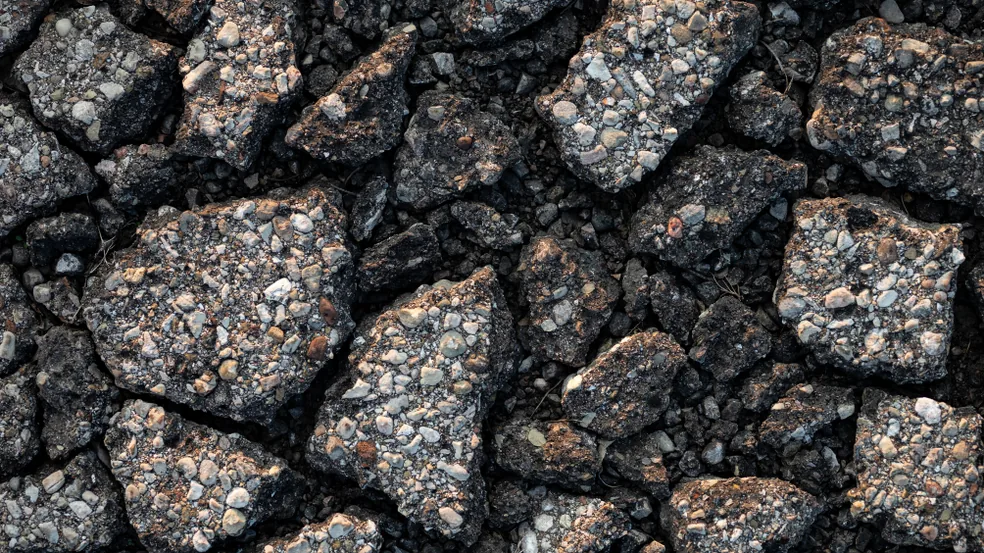
Cracks that make patterns and cracks that run as lines are two different diagnoses
Before naming anything, ask one question about what you are looking at. Does the cracking form a pattern, or does it run as a line?
A pattern means cracks that interconnect and enclose areas - shapes with sides, whether those shapes are small and irregular or large and roughly rectangular. Patterns are produced by something acting across an area. That something is either the ground beneath moving under load or the material itself shrinking as it ages. Either way the report concerns the pavement as a body rather than one weak seam within it.
A line means a single crack with two ends and no enclosed shapes, running roughly along the pavement or across it. Lines are produced by something acting along a seam: a joint where two passes of material met and never became one, a place where the pavement contracted in cold weather and had to relieve the tension somewhere, an old crack working its way up through a newer layer. A line is a local defect in a surface that is otherwise continuous.
The consequence is immediate and it is the reason this distinction is worth more than the vocabulary that follows it. Lines on a sound pavement are maintenance. Caught early they are inexpensive and the treatment genuinely works. Patterns are normally a report on the structure, and treating the top of a pattern does nothing at all about whatever produced it. When the same remedy is proposed for both, that is the moment to ask which of the two the person quoting believes he is looking at.
Reading the distress, one pattern at a time
Each item below has a mechanism, and the mechanism is what tells you which layer is talking. Some are surface reports, meaning the wearing course is worn or damaged while the structure beneath it is intact. Some are structural reports, meaning the base or the subgrade has the problem and the surface is merely where it became visible.
Alligator or fatigue cracking
Interconnected cracks enclosing many small, irregular pieces, usually a few inches across, concentrated exactly where weight is applied most often: the apron in front of a garage, a turnaround, the spot where a delivery vehicle stops every week. It develops from the bottom of the asphalt upward. Each wheel load bends the pavement a little. Where the support below is too weak to limit that bending, the underside of the asphalt goes into tension, cracks initiate there and work up to daylight, and the enclosed pieces get smaller with every further load.
This is a structural report and the least ambiguous one on the list. It says the base is no longer spreading load properly, which in this region almost always means water reached it. Any treatment laid over the top of a fatigued area leaves the cause running below it, and the pieces keep breaking down until the area is cut out and rebuilt.
Block cracking
Cracks meeting at rough right angles and dividing the surface into large rectangles, commonly a foot to several feet across, spread fairly evenly rather than clustering where the traffic goes. It has nothing to do with load. It is shrinkage. An aged, oxidised binder can no longer accommodate the daily and seasonal expansion and contraction of the material, and the surface relieves that stress by splitting into a grid.
This is a surface and material report rather than a bearing capacity one. It turns up most often on lightly used pavement, which surprises people, because it means the part of the driveway nobody drives on looks the worst. The cracks are still open routes for water and they still matter, but the structure below them is frequently in good order.
Longitudinal cracking at a cold joint
A line running in the direction of travel, often strikingly straight, and often precisely where two passes of paving met. When a second pass is laid against an edge that has already cooled, the two do not knit into a single continuous mass. The seam ends up less dense and with less material holding it together than the surrounding pavement. Over time it opens, and once open it takes in water faster than anywhere else on the surface, because it is a vertical path pointing straight down.
On its own this is a surface report about a seam. It turns structural once it has been open long enough to feed the base, and you can see that happening: the edges of the crack start to crumble, and small fatigue patterning appears alongside it. A single clean line is a cheap fix. A line with pattern forming beside it is no longer a single line, and the price changes accordingly.
Transverse thermal cracking
A line running across the pavement, roughly square to the direction of travel, and often more or less evenly spaced where there are several. Asphalt contracts as it cools. A body of it held by friction against the base cannot shorten freely, so tension builds along its length until it fails somewhere and relieves itself. The sharper the cold snap and the stiffer the aged binder, the more likely it becomes.
This is a surface report and, on an otherwise sound pavement, an unremarkable one. Central Virginia does not get the deep sustained cold that produces severe thermal cracking, but it does get abrupt overnight drops, and an older brittle surface will crack at temperatures a newer one would shrug off. These are the cracks most worth treating before winter: straight, accessible, and at present harmless.
Reflective cracking through an overlay
Cracks in a newer surface that appear in the same positions and the same shapes as the cracks in the layer underneath it. An overlay does not stop the old pavement moving. The old crack goes on opening and closing with temperature and flexing under traffic, and it works that movement up through the new material until the new material fails along the identical line. The giveaway is geometry. The pattern matches something that was there before the new layer went down.
What it reports depends entirely on what was buried. A reflected line crack is a nuisance and can be treated. Reflected fatigue patterning means the structural problem that got covered over is still running, and the overlay has now added to the cost of the eventual repair, because the new layer has to come off along with the old one.
Slippage cracking
Crescent or half-moon shaped cracks, with the open side of the crescent pointing the way traffic pushes, usually where vehicles turn sharply, brake hard or pull away. The surface layer has slid across the layer beneath it because the two are not properly attached, commonly because a tack coat was thin, contaminated or left out, or because dust was not cleaned off the old surface before the new one went on. The material bunches up like a rug shoved across a floor.
This is a surface report with a construction cause behind it, and the structure underneath may be entirely sound. It does not spread the way fatigue cracking spreads, but the loosened area will break up under traffic and it will admit water, so the affected patch gets removed and replaced rather than sealed over.
Raveling
Not a crack at all. The surface loses aggregate, beginning with the fine particles, and the texture goes from smooth and dark to coarse, grey and gritty. The binder has oxidised past the point where it can hold the stone, and traffic and rain remove what it can no longer keep. The displaced stone gathers wherever rain carries it, typically at the perimeter and at the bottom of a grade.
This is a surface report and an age report. It says nothing about the base. Caught early it is the one condition a surface treatment genuinely addresses. Left to run, it opens the pavement up over a broad area, lets water in across that whole area rather than at a single line, and eventually becomes a question of thickness that only new material answers.
Potholes
A bowl-shaped hole with steep sides and a ragged rim. A pothole is almost never the first thing that went wrong. It is the end of a sequence: cracking admitted water, the water weakened or washed out part of the base, the asphalt above lost its support, traffic punched the unsupported piece through, and every vehicle since has enlarged the opening.
Read it as a structural report until something proves otherwise. The width of the hole tells you very little on its own. What matters is what the bottom of it is resting on, which is why a hole that reopens in the same footprint after being filled is confirming that the material underneath was never sound in the first place.
Depressions
A dished area that holds water after rain and dries last. There are two possible causes and from standing height they look identical. Either the subgrade below consolidated or lost volume and the pavement settled into the space, or the surface was never graded to drain in that direction and the low point has been there since the day it was built.
Read it as a structural report until the grade proves otherwise, and treat it as urgent either way. A depression is a collector. It holds standing water directly over the part of the base most likely to be weak already, and on clay that water has nowhere quick to go. Depressions get deeper rather than stabilising. Skim-patching the dish with surface material leaves whatever settled underneath exactly as it was, and the dish generally returns within a season or two.
Sealing and filling are two different operations
The two words get used interchangeably in sales conversations, and they describe different jobs with different materials.
Crack sealing means melting a rubberised compound and placing it hot into a crack that has first been cleaned out, and frequently routed to an even shape before anything goes in. It stays flexible once cool, which is the entire point, because the crack is going to keep moving and the treatment has to move with it. It is the right answer for working cracks - the straight lines, the cold joints, the thermal cracks - on a pavement that is otherwise sound.
Crack filling is simpler and cheaper. A material is placed into a crack that is not moving much, to keep water and debris out of it, with no particular expectation that it will stretch. It suits fine, stable, non-working cracking, and it is not a substitute for sealing on a line that is still opening and closing every season.
Neither one is appropriate across an area that has broken into a pattern. Filling every crack in a fatigued patch is a great deal of labour spent on a symptom, and the finished result is a black web over an area that carries on failing at the same rate it was failing before.
Timing follows the weather. The material goes in best on a thoroughly dry surface, and the crack itself wants to be near its widest, which argues for the cooler end of the working season rather than the middle of a hot August. The deadline that matters more is winter. An open crack going into a season with a high count of freeze and thaw crossings is a funnel aimed at the base, and each time the water inside it freezes the crack is levered a little wider.
Full-depth repair, in outline
When the diagnosis comes back structural, the remedy follows a fixed logic. The specifics belong to a site visit rather than to a web page, but the sequence does not change.
- Saw cut a clean perimeter well outside the visible damage. The failed area is always larger than the part that looks failed, because the base under the sound-looking margin is already compromised.
- Remove the asphalt and excavate down through the base until sound, unyielding material is reached. That depth is discovered on the day rather than specified in advance.
- Deal with the reason. If water was arriving from somewhere, a repair that does not change where the water goes is a repair with a timer attached to it.
- Rebuild in compacted lifts. Stone base first, compacted in layers, then asphalt in layers, each one compacted before the next goes down. Compaction is where the strength comes from, and a thick layer placed all at once cannot be compacted properly through its full depth.
This costs several times what surface work costs over the same area, which is precisely why the diagnosis is worth getting right before anybody quotes it. It is also the only operation described on this page that puts load-carrying capacity back into a pavement.
Water is the cause behind most of the above, and the clay here makes it worse
Fatigue cracking, potholes, depressions, crumbling crack edges and most reflective failures share one cause. Water reached the base or the subgrade and stayed there.
A compacted stone base works because the stones interlock and hand load from one to the next. Introduce water that cannot drain away and the fine material within the base turns to slurry, the interlock is lost, and load begins pushing material sideways instead of downward. Below the base, saturated soil loses bearing capacity outright, so the whole assembly is now sitting on something softer than it was designed for.
This is where central Virginia behaves differently from what its winters suggest. Much of the metro west and north of the city sits on Piedmont red clay, which is dense and drains very slowly. Water that gets under a pavement there does not leave over an afternoon. It sits for days, and through a wet spell it may not fully leave at all. East and south, across the fall line onto the coastal plain, sand and silt drain faster but unevenly, with marine clay holding water in some places and not others. That unevenness produces its own problem: one length of a driveway is properly supported and the next length is not, and the pavement has to bridge the difference.
Then add how often it freezes. No individual freeze here is severe, but a surface that crosses freezing repeatedly through a season gets a great many chances to expand the water held in its cracks and its base. And most years a tropical remnant delivers several inches of rain in a single day, which will overwhelm a drainage arrangement that copes perfectly well the rest of the year. Mild winters lead people to discount all of this. The clay is the reason that intuition is wrong.
What a repair looks like once it is finished
New asphalt does not match old asphalt, and it will not come to match it for a long time.
Fresh material is black because its binder is new. The pavement around it is some shade of grey or brown because its binder has been oxidising for years. The new work makes the rest of the driveway look older by comparison, and it stays visibly different while it goes through its own ageing on its own schedule. Texture differs as well, because the mix, the aggregate size and the compaction are unlikely to be identical to whatever was laid originally. A saw-cut perimeter also remains visible as a line, permanently, even where the joint has been properly treated.
None of that is a defect. A repair that is genuinely invisible is either a repair on very new pavement or a repair that was skimmed over the top rather than done.
Where uniform appearance is the goal, the sequence is what gets you there. Do the structural repairs first and let them take a season of traffic. Then, if the pavement as a whole is sound enough to justify the spend, a surface treatment or an overlay can go over everything at once, so the whole area starts ageing from the same point. Reversing that - coating or overlaying first, then cutting repairs into the new surface - wastes the surface work and produces a more conspicuous result than leaving it alone would have.
Every crack is telling you which layer has the problem — common questions
How do I tell a structural problem from a surface problem without digging anything up?
Start with the shape of the cracking. Interconnected cracks enclosing small pieces, concentrated where vehicles sit or turn, are a structural report. Single lines with two ends, running along or across the pavement, are usually a surface report on an otherwise sound driveway. Standing water is the other strong signal, because a dish that holds water is almost always telling you something settled underneath it.
Can an alligatored area just be patched over the top?
A surface patch over fatigue cracking covers the evidence and leaves the mechanism running, so the same pattern comes back through the patch, usually within a season or two. The area is flexing because the base under it cannot spread the load, and that is not something a layer on top can change. Full-depth removal and rebuilding is the only treatment that addresses it.
At what point is repair no longer worth it and replacement makes more sense?
It is mostly a question of how much of the surface is structurally involved rather than how bad the worst spot looks. Scattered patterning in a few defined areas on an otherwise sound driveway is repair work. Patterning distributed across most of the surface means the structure is failing generally, and repairing it piece by piece adds up to more than rebuilding while leaving a patchwork behind. A site visit settles which of the two you have.
Why did the crack come straight back through the new asphalt?
That is reflective cracking, and it means the old crack under the new layer is still moving. An overlay adds material but it does not restrain what is beneath it, so the movement works its way up until the new surface fails along the same line. It is the standard consequence of paving over a problem instead of opening it up and dealing with the cause.
Water stands in one spot for days after it rains. How urgent is that?
More urgent than it looks, particularly on clay. The depression concentrates water over the part of the base that is most likely to be weak already, and Piedmont clay drains slowly enough that the water stays there rather than moving on. Depressions deepen over time rather than settling down, and the cheapest moment to address one is before the asphalt around it starts breaking up.
The worst cracking is on the part of the driveway nobody drives on. How is that possible?
That pattern is usually block cracking, which is shrinkage rather than load damage. An aged binder loses the ability to accommodate expansion and contraction, and the surface relieves the stress by splitting into a grid. Lightly used pavement shows it readily because nothing is happening to the surface to disguise it. The structure underneath is often perfectly sound, though the open cracks still need attention.
What time of year can asphalt repairs be carried out around Richmond?
Hot mix needs to go down and be rolled while it remains workable, which puts the practical window between spring and late autumn, and a dry surface matters as much as the thermometer does. Crack treatment has a narrower ideal window and is best completed before winter, because a winter here delivers a high count of freeze and thaw crossings and an open crack going into that season is the most efficient way to move water into the base.
Will the repaired area ever match the rest of the driveway?
Not for a long time, and never exactly. New asphalt is black because its binder has not oxidised yet, while the surrounding surface has been ageing for years, and the saw-cut edges stay visible as lines. If a uniform look matters, the right order is structural repairs first, a season of traffic, then a surface treatment across the whole area so everything ages from the same starting point.
Talk through your site
Start with the address, roughly how many square feet, and photographs of the worst areas and anywhere water sits after rain.
Related work
Driveway Paving
New asphalt drives, replacements and widenings, from the subgrade up.
Driveway Repair
Potholes, edge failure, settling and the cracks worth chasing.
Sealcoating & Driveway Sealing
What it protects, what it cannot fix, and when it is money wasted.
Parking Lot Repair
Keeping a working lot open while the failed areas get rebuilt.
Parking Lot Paving
New lots and full reconstruction for commercial and multifamily sites.
Parking Lot Striping & ADA Layout
Layout, stall counts, accessible spaces and fire lanes.
Where we do it
Powhatan
Long rural drives, gravel conversions and gravity that works against you.
Chesterfield
Suburban drives and the county clay that decides how long they last.
Glen Allen
West-end subdivisions, commercial strips and tight HOA standards.
Ashland
Older streets, mature trees and root damage under the mat.
Mechanicsville
Hanover-side drives and a lot of deferred maintenance.
Midlothian
Newer construction on ground that has not finished settling.