Home › Services
A new driveway is mostly stone and grading, and a little bit of asphalt
The thing you are actually buying when you pave a driveway is the stone underneath it and the shape you give the ground around it. The asphalt is the cheapest part of the job and the part everybody asks about first.
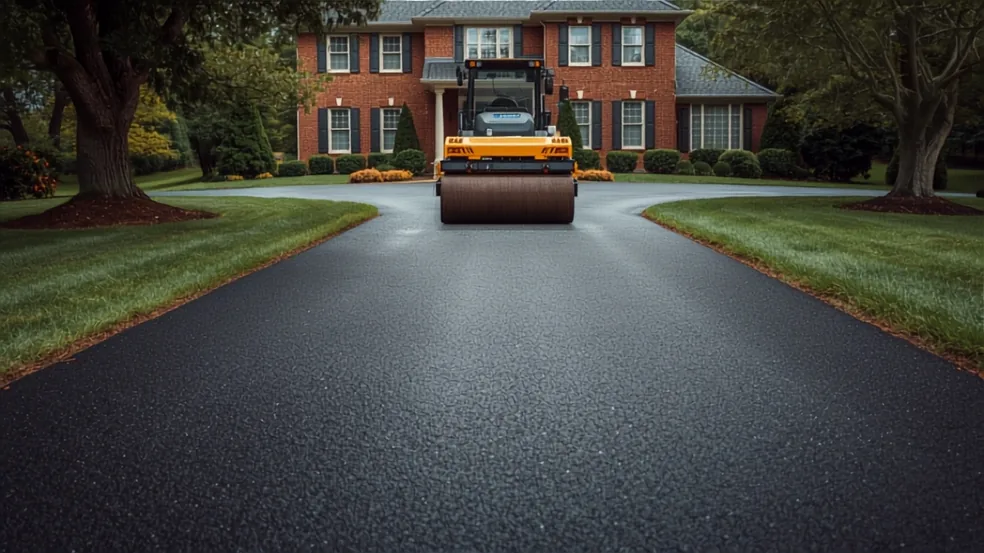
The line item everybody asks about is the one that matters least
Almost every conversation about a new drive opens with thickness. It is the one figure that seems comparable between proposals, and it is the figure a salesperson can offer to improve at no charge. It is also close to the least consequential decision on the job.
A driveway is a load-spreading assembly. A tyre puts a concentrated load onto a small patch of ground. Everything beneath it exists to take that load and hand it down over an area wide enough that the ground can carry it without deforming. The black layer does some of that work. The compacted stone does more of it. The ground itself does the rest, and the ground is the only component on the job with no specification at all until somebody goes and tests it.
So the useful way to read a paving proposal in central Virginia is from the bottom of the page upward. What is being done to the ground once the old surface is off. How much stone is going down, and how it will be compacted. What shape the finished surface will hold, and where the water leaving it is going. Asphalt depth is the last question on that list, not the first.
Bottom up: what a new drive is actually made of
Four things get built, in order, and each one depends on the one below it being right. Getting them out of order, or skipping the first, is how a drive that looked immaculate in its first autumn is in trouble by its third.
The subgrade, which nobody specifies and almost everybody assumes
The subgrade is whatever remains once the topsoil, the old surface and the organic material have been stripped off. West and north of the city, through Glen Allen, Midlothian and out toward Powhatan, that generally means dense red Piedmont clay. East and south of the fall line, through Chester and on toward the coastal plain, it can be sand, silt or a marine clay instead, and those drain unevenly enough that two ends of the same property can behave differently.
Clay is a capable foundation when it is dry and a poor one when it is wet, and the reason it has to be checked rather than assumed is that you cannot tell which you have by looking at it. The usual method is a proof roll: run a loaded vehicle slowly across the prepared surface and watch what the ground does under the wheels. Sound ground barely marks. Unsound ground ruts, pumps water to the surface or visibly deflects and springs back, and those soft areas are almost never spread evenly. They concentrate. A filled stump hole. A run of buried topsoil nobody took out. The wet corner at the foot of a slope where the neighbouring grade drains toward the drive.
What happens next is the decision that separates a drive that lasts from one that does not. A soft area can be undercut and replaced with stone. It can be dried out and recompacted. It can be separated from the stone above with a geotextile so that the base does not slowly migrate down into the clay and disappear. What it cannot be is paved over, because a soft spot under a new drive is a failure with a delay on it, and it will surface in the same place every time it is patched.
A proposal that says nothing about the subgrade is usually not hiding anything. It is assuming, and in this soil an assumption is a wager that the homeowner settles later.
The aggregate base, which is the real variable
The stone layer is where a residential drive gets most of its structural capacity, and it is the line item that varies most between two proposals that read alike. Dense-graded crushed stone works because the pieces are angular and lock against one another when compacted, forming a stiff mat that spreads a wheel load outward as it passes it down. It is a structural layer first. A well-built one also lets water travel sideways toward daylight rather than pooling against the clay.
Depth is set by two things: what the subgrade can carry, and what is going to drive on it. Firm, well-drained ground carrying two cars needs less stone than the same drive over soft clay. A drive that will take a delivery truck, a loaded trailer, an oil truck or the construction traffic of a future addition needs more. Where the ground underneath is doubtful, adding stone is usually the cheapest structural improvement available on the whole job, because stone is inexpensive relative to everything else and it does exactly what it is asked to do.
That is why the question worth asking every bidder is not how thick the asphalt will be. It is how deep the stone is, what it is sitting on, and how the two were checked.
The asphalt, placed in lifts
Hot mix asphalt is placed in lifts. A residential drive is commonly built either as a single lift or as a coarser base course with a finer surface course over it. The base course supplies most of the strength in the black layer. The surface course is tighter and smoother, and its work is to shed water and absorb wear.
Two lifts are not automatically better than one. They earn their place on long approaches, on drives that carry heavier vehicles, and on jobs where the ground and the base are being rebuilt anyway and it makes sense to build the whole section up properly. What matters more than the count is that each lift is placed at the right temperature and rolled while it is still hot enough to move. A crew putting down too much material in one pass often finishes with a surface that looks correct and is not dense through its full depth, which is a problem that only appears later.
Compaction decides service life more than thickness does
Two drives built to the same written specification can have very different lives, and the difference is usually compaction. Compaction drives the air out from between particles and locks them into a dense mass. Stone that has not been compacted properly carries on compacting afterwards, under traffic, unevenly, in the places that get driven on most. Asphalt that has not been compacted properly contains interconnected voids, which means water travels into the mix rather than running off it.
The sequence is unglamorous. The subgrade is compacted. The stone is placed and compacted in layers rather than dumped to full depth in one go. The grade is checked. The asphalt is rolled while hot, starting at the edges. Shortening any of those steps is completely invisible on the day the job finishes, because everything is black and smooth and nobody can see a void.
A year or two later it becomes legible. Wheel paths that sit slightly lower than the ground on either side. A surface losing its fines early and then shedding visible stone, because water is getting into the mix itself rather than off it. Small depressions that appear where nothing changed. Cracking that begins in the wheel track rather than at a joint or an edge. None of that is a surface problem, and none of it is fixed at the surface.
It is also the reason a drive placed during a wet stretch on saturated clay can underperform an identical drive placed in better conditions. Compaction works against material capable of being compacted, and saturated Piedmont clay is not.
Shedding water is a design decision made before the asphalt arrives
The shape of a finished drive is set when the stone is graded, not when the asphalt is laid. Once the black layer is down, the shape is what it is, and changing it later means taking material off or putting material on, both of which are more expensive than getting it right the first time.
The requirement is easy to state. Water has to leave the surface quickly, and it has to leave in a direction that does not create a problem elsewhere. On a residential drive that means a consistent cross-slope, a steady fall from one side to the other, or a crown down the centre that sheds to both sides. Level is not a neutral choice. A dead flat drive holds a film of water across its entire area after every rain, and a drive that holds water is a drive delivering water to its own base, on a clay subgrade that is slow to give it back.
A drive that falls toward the garage is the version of this that never resolves on its own. Every storm sends surface water at the building, the joint at the slab takes the worst of it, and the most heavily loaded part of the whole drive is also the wettest. Correcting it is a grading problem rather than a paving problem: regrading the approach to fall away, building in a reverse crown short of the slab so water is turned aside, or setting a drain across the low point and giving it somewhere to discharge. What does not work is a thicker layer of asphalt over the same shape.
The other half of the question is what happens at the sides. Water leaving the surface has to be received: a shoulder that can take it without eroding, a swale, a ditch line along a rural approach. Concentrating the entire surface onto one point of a soft shoulder produces a rill, then an undercut edge, then a broken edge, in that order and usually within a few seasons.
Ordinary rain is not the test here. The test is the day in most years when the remains of a tropical system park over central Virginia and put several inches down in hours. Grading that copes easily the rest of the time can be completely overrun then, and wherever the water backs up on that day is where the drive will show its first structural distress.
Overlay, replacement or full reconstruction
Three quite different jobs get described as repaving, and they differ by far more than price. Knowing which one a property actually needs is most of the value in a site visit.
- Overlay. New asphalt is placed over the existing surface, which becomes part of the structure. Nothing underneath is touched or corrected. The finished drive sits higher than it did.
- Removal and resurfacing. The old asphalt comes off, the existing stone base is inspected, repaired and regraded where it needs it, and new asphalt goes down on top of it. Elevation stays close to where it was.
- Full reconstruction. Surface and base both come out, the subgrade is checked and corrected, new stone is placed and compacted to a specified depth, grading is reset, and the drive is built from the ground up. This is the only one of the three that can change what the drive is capable of carrying.
When an overlay is the wrong purchase
An overlay is a genuine option in one set of conditions: the existing pavement is structurally sound, it already drains properly, the cracking is isolated rather than patterned, the edges are supported, and the elevation can absorb the extra thickness at the street, at the garage and along both sides. In that situation it is good value and it is the sensible buy.
Outside that, it is the most expensive way to purchase two years. Specifically, it is the wrong call where any of the following is true.
- Interconnected cracking in the wheel paths, the turnaround or the parking area. That pattern means the structure beneath has stopped distributing weight, and a new layer over it reproduces the same pattern from below, usually within a couple of seasons.
- Water stands anywhere on the surface. An overlay follows the existing shape. A low spot paved over is a low spot at a higher elevation.
- The drive is already level with the garage slab, a threshold or a walkway. Adding thickness either creates a lip at the building or leaves nowhere for water to go but toward it.
- The edges are unsupported or broken. Fresh asphalt placed against an unsupported edge breaks away at the perimeter the same way the original did.
- Patches in the same area have been replaced more than once. That is a structural report, not a workmanship complaint.
- A live root is lifting the surface. The root is still growing, and the new layer will telegraph the heave as reliably as the old one did.
- The existing pavement is already thin and brittle across its whole area. An overlay needs something competent to sit on, and a surface that flexes underfoot is not it.
Converting gravel to asphalt
Long gravel approaches are common west and south of the city, through Powhatan and western Chesterfield, and the conversion to asphalt is one of the more misunderstood jobs in residential paving. It is not a surfacing project. It is a drainage and grading project that happens to finish in black.
What carries over is the alignment, the general corridor and sometimes a useful share of the stone. Gravel that is clean, angular and of a workable gradation can often be reclaimed, supplemented, regraded and compacted as part of the new base, which is real money saved. Whether that is possible is settled by digging into it and looking, not by looking at the surface.
What does not carry over is the wear. Years of blading tend to flatten the crown a gravel drive was built with, and push material to the sides into berms that now stop water leaving the surface. Organic material and mud work upward through the stone in the low places. The ruts and the soft spots at the bottoms of grades are exactly the areas that will need correcting before anything is placed over them.
The important difference is how the two surfaces fail. A gravel drive complains. It ruts, it washboards, it loses stone downhill, and the owner responds with a load of gravel and a box blade a couple of times a year. Asphalt does not complain. It absorbs the same conditions in silence and then fails at a point, all at once, and the repair is not a load of stone.
On a long approach the real work is interception. A drive running several hundred feet down a grade collects water along its full length, and that water has to be taken off at intervals rather than carried to the bottom and released in one place. That means a ditch line that is actually at grade instead of silted flat, cross-fall that consistently turns water off one side, culverts where the drive crosses a low point, and shoulders water can leave across rather than pond behind.
It is worth saying plainly that the conversion is not always the right purchase. A well-drained gravel approach that is seldom driven is not a bad surface, and the same money spent on ditching, a deeper stone section and a proper crown may deliver more than a thin black layer over an uncorrected grade. The conversion earns its cost when dust, mud, washboarding and the annual regrading have themselves become the complaint.
Edges and shoulders, which is where most drives begin failing
A concrete slab holds its own perimeter together. Asphalt has nothing doing that job. The edge of an asphalt drive is held up entirely by whatever material sits against it, and where that material is missing the edge is a cantilever carrying a wheel load.
Two things support a residential edge. The first is how the edge is built: rolled to a compacted taper rather than left as a vertical face, so that the material at the perimeter is as dense as the material in the middle. The second is the shoulder, brought up against the finished pavement and compacted, level with the surface or barely below it, so that a wheel leaving the drive is carried and water crossing the edge runs away rather than over a lip and down a face.
Everything that goes wrong at the perimeter follows from one of those being absent. A mower wheel running the same line week after week wears a channel beside the pavement. The channel collects water. Water undercuts the edge, and the unsupported material breaks away in pieces, at which point the drive is narrower and the channel is deeper. On sloping rural approaches, water that runs along the edge instead of across it will excavate a shoulder within a few seasons.
Backfilling, grading and establishing the shoulder is part of paving a drive, not an extra at the end of it. It costs very little while the equipment is there and a great deal afterwards.
The apron and the two joints that do the most work
Two connections on a residential drive carry loads that the rest of the pavement never sees, and both of them are joints between materials that behave differently.
At the street, the apron takes every vehicle that enters the property, and it takes them turning, at low speed, with the wheels loaded sideways. That is the most punishing movement asphalt experiences. It is also where a delivery truck or an oil truck puts its weight. It deserves the deepest section on the job and the most careful compaction, and where it meets the road surface or a curb cut it has to match grade cleanly, because a lip there is struck by every vehicle and broken down a little further each time. Work in the public right of way is not the homeowner's to specify, and what is permitted at the connection depends on who maintains the road, so that is a question to settle before the job is scheduled rather than on the morning it starts.
At the garage, the drive meets a concrete slab that is not going anywhere. The asphalt beside it will settle slightly and move seasonally, the slab will not, and the seam between them opens. That seam sits at the most heavily loaded and most frequently wetted spot on the whole drive. It wants two things: a grade that falls away from the building so that surface water is never arriving there in the first place, and a joint kept closed as ordinary maintenance rather than left open through a freeze-thaw winter.
The same logic applies wherever the drive meets a walkway, a concrete pad or a parking apron. Every one of those seams is a route into the base, and where winter swings back and forth across freezing week after week, an open seam becomes a lever that works on the pavement all season.
Sequencing, access and the first season
Paving a residential drive is not a single event. The work runs in a sequence, and the property is affected for longer than the day the trucks are there.
Excavation and stripping come first, then the subgrade check and whatever correction it calls for, then stone placed and compacted in layers, then grade verification, then asphalt, then edges and shoulders. On a straightforward suburban drive in Mechanicsville or Glen Allen the whole sequence is short. On a several-hundred-foot approach in Powhatan with ditching and culvert work in it, the stone can be in place and driveable for a while before the asphalt goes down, which is often the easier way to live with the job.
Once asphalt is placed it has to cool before it carries traffic. Foot traffic comes back quickly. Vehicles wait until the mat has cooled through its depth, and how long that takes depends on air temperature, the thickness placed and how much sun or shade the drive gets. A drive under heavy hardwood canopy in October behaves differently from one in open sun in July, which is why the answer is given on site rather than in advance.
Through its first hot season a new surface stays softer than it will ever be again. That is normal and it is not a defect, but it does mean a few things are worth avoiding in the meantime.
- Turning the steering wheel while the vehicle is stationary, which scuffs and tears a fresh surface.
- Point loads: trailer jacks, kickstands, ladder feet, jack stands, dumpster wheels. A scrap of plywood under any of them spreads the load and prevents the impression.
- Parking in the same spot every afternoon during the hottest weeks, which presses tyre impressions into a soft mat.
- Heavy delivery and construction vehicles. If a renovation, a pool or a septic job is in the plan, the honest sequence is to do that work first and pave afterward.
- Driving off the edge before the shoulder has been built back and has settled.
A new driveway is mostly stone and grading, and a little bit of asphalt — common questions
How deep should the stone base be under a new driveway?
There is no single correct depth, which is why a number quoted before anyone has looked at the ground is a guess. It is set by what the subgrade can carry and by what will drive on the finished surface. Firm, well-drained ground carrying passenger vehicles needs less than soft clay carrying a loaded trailer. The point of the site visit is to find out which of those you have.
Is thicker asphalt worth paying for?
Within limits, and it is rarely the best place to put extra money. Additional asphalt over a base that is too thin or a subgrade that was never checked buys very little, because the layer that is failing is still failing. The same money moved into stone depth, subgrade correction or drainage generally buys far more service life. Where extra asphalt does earn its keep is on drives that regularly carry heavy vehicles.
Can the gravel already on my drive be used as the base?
Sometimes a good share of it can. Clean, angular stone of a usable gradation can often be reclaimed, supplemented and recompacted as part of the new base, which is real savings. What cannot be reused is material that has been contaminated with mud and organics from below, which tends to be worst in the low areas and the ruts. Digging into it in a few places is how that gets settled.
How soon can I drive on a new asphalt driveway?
Foot traffic returns quickly, and vehicles wait until the mat has cooled through its full depth. That depends on the thickness placed, the air temperature and how much shade the drive sits in, so the timing is given on site rather than as a rule. Through the first hot season, avoid turning the wheels while stopped and put a board under trailer jacks and ladder feet.
My driveway slopes down toward the garage. Can that be fixed when it is repaved?
Usually, but it is a grading job rather than a paving job, and it has to be priced as one. The options are regrading the approach so it falls away from the building, building a reverse fall in ahead of the slab so water is turned aside before it reaches it, or setting a drain across the low point with somewhere for it to discharge. Simply laying new asphalt over the existing shape reproduces the same problem at a higher elevation.
One bid includes a fabric layer under the stone and the others do not. What is it for?
A geotextile is a separation layer. It keeps the stone base and a soft, fine-grained subgrade from mixing, which on wet clay is a genuine failure mechanism: the stone gradually works down into the clay, the clay pumps up into the stone, and the base thins without anybody adding a vehicle or a year of wear. It is not needed everywhere. It is worth having where the ground came up soft during the proof roll.
What happens where the driveway meets the road?
That connection is the apron, and it is the hardest-working part of a residential drive because every vehicle crosses it while turning. It should be built with the deepest section on the job and matched cleanly to the existing road surface or curb cut so no lip is left standing proud. What is allowed in the public right of way depends on who maintains the road, so that question is settled before the work is scheduled.
Does an asphalt driveway need an edging or a border?
It needs support, which is not quite the same thing. A compacted, tapered edge with a shoulder built up against it and held at the surface level does the job on most residential drives. A concrete curb or a paver border is a reasonable choice where the drive is cut into a slope, where mower traffic keeps carving a channel alongside, or where the edge is doing decorative work. A border over an unsupported edge is only decoration.
Talk through your site
Start with the address, roughly how many square feet, and photographs of the worst areas and anywhere water sits after rain.
Related work
Driveway Repair
Potholes, edge failure, settling and the cracks worth chasing.
Sealcoating & Driveway Sealing
What it protects, what it cannot fix, and when it is money wasted.
Asphalt Repair
Patching, full-depth repair and reading what a failure is telling you.
Parking Lot Repair
Keeping a working lot open while the failed areas get rebuilt.
Parking Lot Paving
New lots and full reconstruction for commercial and multifamily sites.
Parking Lot Striping & ADA Layout
Layout, stall counts, accessible spaces and fire lanes.
Where we do it
Powhatan
Long rural drives, gravel conversions and gravity that works against you.
Chesterfield
Suburban drives and the county clay that decides how long they last.
Glen Allen
West-end subdivisions, commercial strips and tight HOA standards.
Ashland
Older streets, mature trees and root damage under the mat.
Mechanicsville
Hanover-side drives and a lot of deferred maintenance.
Midlothian
Newer construction on ground that has not finished settling.