Home › Services
A restripe reproduces every decision in the old layout
Line marking is the only part of a parking lot that carries a legal exposure independent of its condition. Fresh paint over a layout that was never right has not maintained anything. It has taken a maintenance job and turned it into a liability, in bright white, with a date on it.
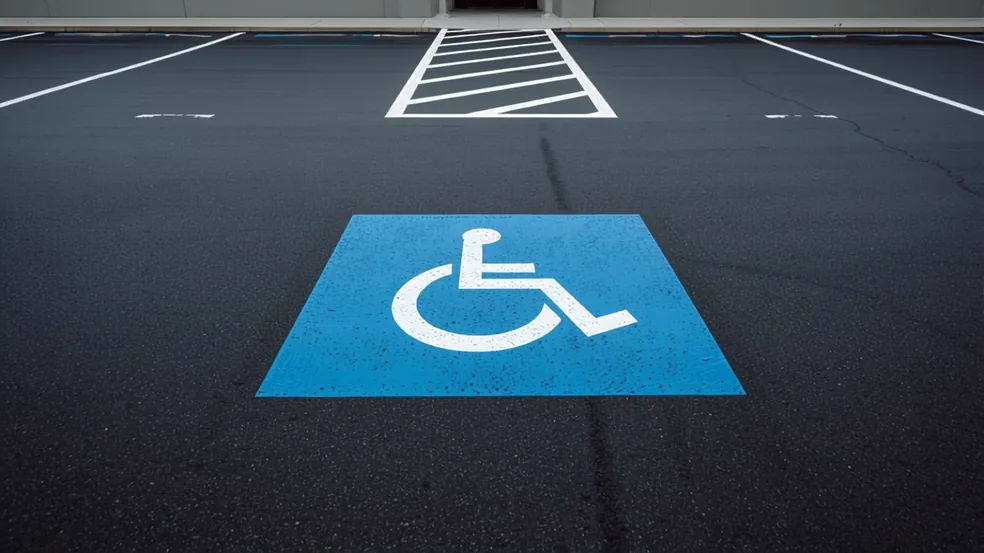
Tracing the faded lines is the trap, not the shortcut
The default instruction given to a striping crew is to put the lines back where they were. It is an entirely natural instruction. The old layout is right there on the pavement, it is what everybody is used to, and reproducing it looks like the low-risk option.
It is not the low-risk option. Every stall position, every aisle width, every arrow and every accessible space in that faded layout is a decision somebody made, possibly decades ago, possibly under a different set of rules, possibly for a building that has since been extended or subdivided or converted to a different use. A repaint adopts all of those decisions and signs the property owner's name to them afresh.
The specific risk sits with accessibility. Requirements have changed over the years, and a layout that was acceptable when it was first marked may not meet what applies now. Repainting it does not preserve a grandfathered position so much as produce a newly marked lot that does not comply, which is a materially worse position to be in than a faded one. This is the point at which the authority having jurisdiction and a professional engaged on the project earn their place in the conversation, and it is worth having that conversation before the crew is booked rather than after the lot is dry.
The other thing a repaint inherits is inefficiency. Lots frequently contain stalls nobody can use because a column, a curb or a landscape island went in afterwards, aisles that are awkward for the vehicles actually using them, and circulation that fights itself at the entrance. None of that is visible in a faded layout, because faded layouts are read as history rather than as a proposal. Laid out fresh on paper, the same lot often yields better parking and better flow without a square foot of new pavement.
So the useful framing is that a restripe is a chance to lay the lot out, which happens to cost about the same as copying it. The measuring and marking out is where the work is either done properly or skipped, and the painting itself is the easy part in both cases.
Accessible parking: the general shape of it, and who actually decides
Accessible parking is not simply a matter of painting a symbol in a stall near the door. It is a set of connected elements, and a layout can have several of them right and still not work as intended, because the requirement is about a person being able to get from a vehicle into the building.
- Accessible parking spaces themselves, in a number and of a size that is governed by rules rather than by what fits. How many a lot needs relates to the size and use of the lot, and it is not something to estimate.
- Access aisles beside those spaces, which are the marked areas that allow somebody to deploy a ramp or a lift, or simply to open a door fully and transfer. An access aisle is functional space, not a buffer, and parking in it or across it defeats the space it serves.
- Signage identifying the spaces, positioned so that it remains visible and is not obscured by a parked vehicle. The form and placement of signage is set by the applicable rules and by local requirements.
- A connected accessible route from those spaces to the building entrance, which means a continuous path that does not require somebody to travel behind parked cars or cross an obstruction. A perfectly marked space that connects to nothing useful has not solved the problem.
- Surface condition and slope in and around those spaces and along that route. Slope matters in both directions and the acceptable range is defined by the rules, which is why an accessible area that has settled, ponds water, or has been patched unevenly can fall out of compliance without anybody having changed a line. Frost heave and settlement over a slow-draining subgrade can do this quietly over several winters.
What is deliberately absent from the description above is any number. Counts, dimensions, slopes and ratios are all governed by the applicable accessibility rules and by the authority having jurisdiction for your property, and they are not the sort of thing to take from a web page, a previous lot, or a striping crew's recollection. They also interact with each other and with the specific circumstances of the site.
The practical advice is short. Before a lot is restriped, have the accessible parking, the access aisles, the signage and the route reviewed against what currently applies, by a professional engaged on your project, and confirm the interpretation with the authority having jurisdiction. If the layout needs to change, the moment of a restripe is by a wide margin the cheapest time to change it. If it does not, you have a documented answer rather than an assumption.
One more point that owners often miss: a change to the building can change what the parking has to do. A tenant fit-out, a change of use, an extension or a subdivision of a suite can all alter the picture, and the parking is usually the last thing anybody thinks about. If anything about the building has changed since the lot was last laid out, treat the layout as unsettled until it has been checked.
Stall angle, aisle width and the trade-off nobody states out loud
Layout is a negotiation between how many vehicles fit and how easily they get in and out, and the two pull against each other in every direction. More stalls means narrower aisles or tighter stalls. Easier manoeuvring means fewer spaces. There is no arrangement that wins both, and a proposal that implies otherwise has not been thought through.
Perpendicular stalls, set square to the aisle, yield the most spaces per area and allow two-way circulation, which keeps the drive pattern simple. They also demand the most room to turn into, which is what makes tight perpendicular lots feel awkward, particularly for larger vehicles and particularly when the lot is full.
Angled stalls are easier to enter and leave and reduce the manoeuvring a driver has to do, which makes a lot feel calmer and speeds up turnover. The cost is that angled layouts are inherently one-way, they consume more area per space, and they yield fewer spaces overall. The shallower the angle, the easier the parking and the greater the loss in capacity.
Aisle width is the variable owners are most often tempted to trim, and it is the one that punishes them. An aisle that is tight for the vehicles actually using the lot produces slow circulation, contact between vehicles, damage at the corners of stalls, and pavement distress where drivers turn repeatedly in the same tight arc. It also affects what a delivery vehicle or a refuse truck can physically do on the site, which is a much larger problem than a couple of lost spaces.
Two site-specific factors matter more than the general ones. The first is what actually parks there: a medical office with older patients and a lot of door-opening needs different space from a lot serving a commuter population. The second is what else has to move through the lot, because fire access is a requirement set by the local fire authority rather than a matter of layout preference, and the turning space a service vehicle needs has to survive whatever the layout does.
The honest conclusion is that squeezing the maximum number of stalls out of a lot is usually the wrong objective. A lot that is unpleasant to use loses customers quietly, damages its own pavement at the pinch points, and generates complaints that never get attributed to the layout that caused them.
Traffic control markings, and what is not a matter of preference
Beyond the stalls, a lot carries a second layer of marking whose job is to tell drivers and pedestrians what to do. It is usually specified casually and it is the part that does the most to prevent incidents.
- Directional arrows, which make a one-way aisle actually one-way. In an angled layout they are not decoration; the geometry only works if traffic flows the intended way, and without arrows it will not.
- Stop bars and stop markings at the points where lot traffic meets a public road or crosses a main internal aisle. The exit onto the road is the highest-consequence conflict point on most commercial sites and it is frequently unmarked.
- Crosswalks on the routes pedestrians genuinely take between parking and the entrance, rather than on the routes that look neat on a plan. A crosswalk placed where nobody walks does not move people; it just marks pavement.
- Fire lanes, including the extent of the lane, the marking itself and any wording. This one is not a design choice. Fire lane marking is set by the local fire authority, and the same site can be treated differently from one jurisdiction to the next across this metro, so the answer comes from them rather than from a template.
- Loading zones and delivery areas, marked so that a delivery vehicle has somewhere defined to stop. An unmarked loading area means trucks stop wherever is convenient, which is usually across an aisle, a crosswalk or an access aisle.
- Hatched areas and keep-clear zones protecting things that must not be parked in front of: gates, doors, utility structures, the area beside an accessible space, and the approach a refuse truck needs to reach a dumpster.
The through-line is that this layer of marking exists to resolve conflicts between vehicles and people before they happen. Where a lot has a recurring complaint about near misses at a particular corner, or about a truck blocking an aisle every morning, the answer is very often a marking decision that was never made rather than a driver behaviour problem.
Materials, and where each one is worth what it costs
There is a genuine range of marking materials and the differences between them are real, but the right choice is site-specific rather than a straightforward ladder from cheap to good.
- Water-based traffic paint is the standard material for most commercial lots. It goes down quickly, it dries quickly in warm conditions, it has a low odour, and it is the most straightforward to reapply. The trade-off is service life, particularly in wheel paths and turning areas. On a typical lot that is repainted on a cycle anyway, this is usually the sensible choice, and the money saved is better spent on getting the layout right.
- Solvent-based paint holds up better in cold or damp conditions and generally lasts somewhat longer on the surface. The cost is odour, ventilation considerations and restrictions that vary by location and by the type of site. It earns its place where the weather window is tight or the conditions are marginal for a water-based product.
- Thermoplastic is applied hot and fuses into the pavement surface rather than sitting on top of it as a film. It is substantially thicker and lasts far longer, particularly where tyres cross it repeatedly. It costs considerably more to apply and it needs a sound surface to go onto, because a thick, durable marking on failing pavement fails with the pavement. It makes sense on high-traffic crossings, arrows at busy conflict points, stop bars and heavily used entrance markings, rather than across an entire lot.
- Reflective glass beads can be added to paint while it is wet so that the marking returns headlight light back toward the driver. On a lot with limited lighting, or one used heavily after dark, this is a modest addition with a real effect on night visibility. Beads wear off under traffic before the paint does, so the reflectivity has a shorter life than the line.
The most common material mistake is not choosing the cheap option. It is choosing the expensive option uniformly. Putting a long-life material across every stall line in a lot spends heavily on lines that see almost no wear, while the arrows and crossings that actually get driven over are painted the same as everything else. Spending by wear location rather than by area is what makes the budget work.
The second most common mistake is applying a durable material over a surface that is about to be resurfaced or is already breaking up. The marking cannot outlast what it is applied to, so the condition of the pavement caps the value of the material no matter what is specified.
Surface preparation and timing, which decide whether any of it lasts
Marking fails early far more often because of what it was applied to than because of what it was made of. Paint is a thin film adhering to a surface, and it can only adhere to what is actually there.
Dirt, dust, sand, pollen and the fine grit that accumulates along curb lines all sit between the paint and the pavement. Paint applied over them adheres to the debris rather than to the asphalt, and it lifts in sheets when traffic starts. Blowing or sweeping the surface before marking is not a courtesy; it is the difference between a line that lasts a season and one that lasts years. Spring work in this region needs particular attention because of the pollen load.
Moisture is the other common cause. Pavement that looks dry can still be damp in the texture of the surface, especially in shaded areas of a lot, early in the morning, or after overnight dew. Marking applied over that moisture will not hold. This matters here because humidity stays high through the summer and because a shaded corner of a lot under mature trees can remain damp long after the open areas have dried.
Fresh sealcoat is a trap of its own. Sealer needs time to cure before anything is marked over it, and the required window depends on temperature, humidity and how heavily it was applied. Marking applied too soon sits on a surface that is still moving underneath it and comes away in strips. On a humid stretch in this metro, that window is longer than on a dry breezy day, and rushing it wastes both the marking and the goodwill of everybody who has been parking somewhere else.
New asphalt has a waiting period too. A fresh surface needs time before it will accept and hold paint properly. The exact wait depends on the mix, the thickness, the weather and the season, and it is one of the reasons a newly paved lot may be open to traffic with only temporary marking on it for a while.
Temperature sets the boundaries at both ends. There is a minimum surface and air temperature below which paint will not form a proper film, which is what makes late autumn and winter work unreliable here even on mild days, because the pavement stays cold long after the air warms. At the other end, a very hot surface can cause paint to skin over before it has properly wetted the pavement.
Sequencing: why marking goes last, and why that is the cheap moment to change
Marking is the final operation on any pavement project, and the reason is obvious once stated: anything applied to the pavement afterwards covers it. Sealcoat over fresh lines destroys them. Asphalt over fresh lines buries them. So marking waits for paving, for crack sealing, for patching and for sealcoating, in that order, with each of those having a cure window of its own before the next step can begin.
That sequencing has a consequence worth planning around. If a lot is being paved or sealed, every line on it is coming off anyway. The layout is, for a period, a blank sheet. Changing stall angles, widening an aisle, relocating accessible parking, adding a crosswalk or reconfiguring the circulation at the entrance costs essentially nothing extra at that moment, because the marking is being done regardless and the only additional work is the measuring and setting out.
Make the same changes at any other time and they cost considerably more, because the existing lines have to be removed first. Removal is its own operation, it is never invisible, and on asphalt it usually leaves a shadow or a scar where the old line was. A lot that has been reconfigured without resurfacing tends to show its previous layout in raking light for years, which confuses drivers and looks like neglect.
So the decision point on layout is not when somebody notices a problem with the parking. It is the moment the paving or sealing scope is being written. That is when the question should be asked explicitly: is this layout the one we want back, or is this the moment to fix it. Owners who skip that question generally end up living with the answer for the life of the surface.
There is one more sequencing note. Line marking on a lot that is about to be resurfaced is money spent twice. Where a resurfacing decision is genuinely likely within a short horizon, marking the lot in a low-cost material to keep it usable, and doing the proper layout work after the paving, is the better order.
Wear patterns and what they tell you about how the lot is really used
Before any lot is remarked, it is worth walking it and reading what has worn away. Worn marking is a record of actual behaviour, and it frequently disagrees with the layout on the plan.
Lines that have worn out while the lines beside them are intact show where vehicles are crossing rather than parking. A stall line worn away at one end tells you drivers consistently overshoot or cut that corner, usually because the aisle is tight at that point or because the entry angle is awkward. A crosswalk worn only across part of its width shows the walking route people actually take, which is often diagonal to the one that was marked.
Arrows worn in an aisle where the traffic is supposed to be one-way are worth particular attention, because they mean the arrow is being driven over rather than followed. Combined with scuffing at the wrong end of the aisle, that is the lot telling you its circulation is being used in reverse, and repainting the same arrow will not change it. The fix is usually physical: an island, a curb, a hatched area or a relocated entry.
Pavement wear reinforces the same reading. Polished or scuffed asphalt shows where vehicles turn repeatedly. A rutted line across parking bays shows a cut-through that was never intended. Distress concentrated at one corner of the lot shows where the heavy vehicles actually go, which is the single most useful thing to know before any decision about zoning, marking or future resurfacing.
The point of reading all of this is that the lot has been running an experiment for years and the results are painted onto it. A layout that ignores the evidence is going to be ignored in the same way the last one was. A layout that accommodates the routes people already take, or that physically prevents the ones that cause problems, gets used as intended, which is the only measure of a layout that matters.
A restripe reproduces every decision in the old layout — common questions
Can you just repaint the lines exactly as they are now?
It is possible and it is usually the wrong instruction. A repaint adopts every decision in the existing layout, including any that no longer meet current accessibility requirements, and a freshly marked non-compliant lot is a worse position than a faded one. Have the accessible parking, access aisles, signage and route reviewed by a professional engaged on your project and confirmed with the authority having jurisdiction before the crew is scheduled.
How do we know whether our accessible parking still complies?
That question has to be answered by someone applying the current rules to your specific site, not by comparison with a neighbouring lot. The elements involved include the spaces themselves, their access aisles, signage, a connected route to the entrance, and the condition and slope of those areas. Counts, dimensions and slope limits are governed by the applicable rules and by the authority having jurisdiction, so ask them and a professional engaged on your project.
Our lot has settled and now water sits in the accessible spaces. Is that a striping issue?
No, and repainting will not address it. Surface condition and slope in accessible areas and along the accessible route are part of what the rules speak to, so pavement that has settled or ponds water may need correcting as pavement work before the marking goes back down. Confirm the position with the authority having jurisdiction and a professional engaged on your project, because the pavement fix has to come first in the sequence either way.
Should we use thermoplastic or ordinary traffic paint?
Most often both, in different places. Thermoplastic is thicker, fuses into the surface and lasts far longer where tyres cross it, which makes it worth the cost on crossings, stop bars, arrows and entrance markings. Standard traffic paint is the sensible choice for stall lines, which see very little wear. Applying the expensive material everywhere spends heavily on lines nothing drives over.
How long after sealcoating or paving can the lot be striped?
Longer than most people expect, and the wait is not fixed. Sealer has to cure before anything goes over it, and the window stretches out in humid conditions, which this region supplies for much of the summer. New asphalt also needs time before it will hold paint properly. Marking applied too early comes away in strips, so the wait is protecting the money already spent rather than delaying the job.
Can we add more parking spaces by restriping?
Sometimes, and it is worth having the layout drawn rather than assumed. Changing stall angle or tightening the arrangement can yield more spaces, but every space gained comes out of aisle width or manoeuvring room. Tight aisles cause contact damage, slow circulation and pavement distress at turns, and they can compromise what a delivery or service vehicle is able to do on the site. Fire access is set by the local fire authority and is not part of the trade.
Who decides how our fire lanes are marked?
The local fire authority does. The extent of the lane, how it is marked and any required wording come from them, and treatment can differ from one jurisdiction to another across this metro, so a layout copied from another property is not a safe reference. Ask them directly before the marking is specified, because changing it afterwards means removing lines rather than simply painting different ones.
Is it worth restriping a lot we plan to resurface in a year or two?
Generally not in any durable material, because every line will be removed by the resurfacing. Keeping the lot usable and legible with low-cost marking in the meantime and doing the proper layout work after paving is the better order. Resurfacing is also the cheapest moment there will ever be to change the layout, since the setting out is happening anyway and no old lines have to be removed.
Talk through your site
Start with the address, roughly how many square feet, and photographs of the worst areas and anywhere water sits after rain.
Related work
Driveway Paving
New asphalt drives, replacements and widenings, from the subgrade up.
Driveway Repair
Potholes, edge failure, settling and the cracks worth chasing.
Sealcoating & Driveway Sealing
What it protects, what it cannot fix, and when it is money wasted.
Asphalt Repair
Patching, full-depth repair and reading what a failure is telling you.
Parking Lot Repair
Keeping a working lot open while the failed areas get rebuilt.
Parking Lot Paving
New lots and full reconstruction for commercial and multifamily sites.
Where we do it
Powhatan
Long rural drives, gravel conversions and gravity that works against you.
Chesterfield
Suburban drives and the county clay that decides how long they last.
Glen Allen
West-end subdivisions, commercial strips and tight HOA standards.
Ashland
Older streets, mature trees and root damage under the mat.
Mechanicsville
Hanover-side drives and a lot of deferred maintenance.
Midlothian
Newer construction on ground that has not finished settling.