Home › Services
Every repair decision starts with one question about the damage
Almost every residential driveway repair is a triage question: is this distress reporting on the surface, or on the base underneath it. The answer moves the cost by an order of magnitude, and it is settled by looking, not by guessing.
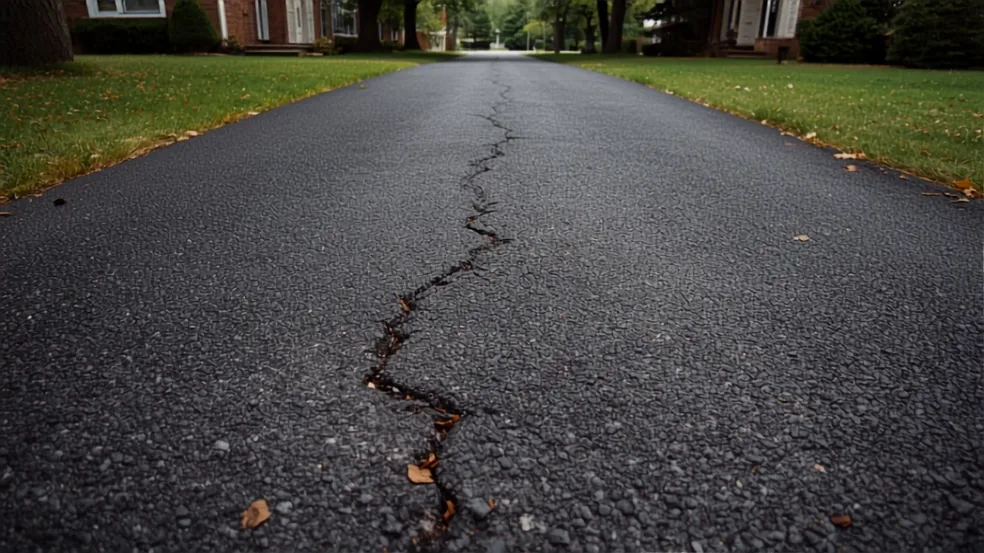
Two repairs that look alike and are not
Stand at the top of a tired drive and the problems all present the same way: dark lines, broken pieces, a rough patch, a hole. Underneath that surface resemblance there are only two categories, and they behave completely differently.
Surface-origin distress means the pavement is intact as a structure and the top of it has aged, scuffed, cracked from temperature, or lost binder. The layers below are doing their job. These problems are cheap to deal with and they stay dealt with, provided water is not being let in somewhere else.
Structural distress means the black layer is fine as a material and is being asked to bridge something that has stopped carrying. Water has got into the stone, or the clay under the stone has softened, or the base was never thick enough for what drives on it. The surface is only the messenger. Anything done at the surface leaves the cause running, which is why the same repair keeps needing doing in the same place.
Sorting a drive into those two categories before anybody quotes anything is the single most valuable half hour available. It is not difficult, and most of it can be done without tools.
The tests that separate surface from structure
These are the checks worth making on your own drive before a site visit, because they change what you are asking for and they make the quotes you receive comparable.
- Read the shape of the cracking. A crack that runs as a single line, along the drive or across it, is ordinary. A crack that has branched into a network of interconnected pieces is a different animal: that pattern forms when the pavement is flexing under wheel loads, which means the layer below has stopped spreading them. Pattern beats width every time. A hairline network is more serious than one wide, lonely line.
- Look at where it concentrates. Distress in the wheel tracks, in the turnaround, in the spot where a vehicle sits every night, or at the flare where trucks swing in, is load-related and therefore structural. Distress spread evenly across the whole surface with no regard for where anyone drives is usually age.
- Press the broken area with a boot heel. Pieces that rock, tilt or feel disconnected from their neighbours mean the pavement there has already broken into blocks and is riding on whatever is beneath. Pieces that are solid underfoot are still acting as pavement.
- Probe the crack. Slide a stiff wire or a screwdriver into it. If it stops at the bottom of the asphalt, the crack is in the pavement. If it slides on into soft, wet material below, the base is saturated and the crack is a delivery pipe.
- Walk the drive half an hour after rain stops. Mark every place water is still standing. That map is worth more than any other single observation, because standing water shows both where the drive has already deformed and where the next failure is being manufactured.
- Watch it deflect. Have someone drive across slowly while you look along the surface from the side, at a low angle. Pavement that visibly dips and rebounds under the tyre is flexing on a base that cannot carry. Sound pavement does not move enough to see.
- Check the history of the spot. A place that has been patched once is information. A place that has been patched twice is a diagnosis nobody acted on, and it will need a different kind of work this time.
- Note the season. Distress that appears or worsens in late winter is usually water that was already in the base being worked on by a climate that crosses freezing dozens of times between December and March.
Full-depth patching, and why the cut is always bigger than the damage
Full-depth repair is the honest answer to structural distress in a defined area. The failed pavement is saw-cut out in a clean rectangle with square vertical faces, the material is removed, and the excavation continues down into the base rather than stopping at the bottom of the asphalt. What comes out is inspected. Wet, contaminated or missing stone is replaced with fresh material and compacted in layers. Only then does asphalt go back in, placed in lifts and compacted, with the perimeter joint sealed so that the seam does not become the next entry point.
It costs several times what surface work costs on the same square of driveway, and it is the only thing on this page that actually restores load-carrying capacity.
The part that surprises people is the size of the cut. The repair footprint is always larger than the damage you can see, and that is not upselling, it is geometry. The visible break is roughly the middle of the failure, not its boundary. Water spreads through a base laterally, so the softened material extends past the last crack, usually by a good margin and often unevenly in the direction of the slope. The only way to find the edge of sound material is to excavate until the ground stops being soft.
Cutting the patch tight to the visible damage guarantees a second failure and puts it in the worst possible place. The new pavement then sits partly on material that is already compromised, the joint lands inside the zone that is still moving, and within a season or two a ring of cracking appears around the patch. That is the origin of the patched-patch pattern you see on old drives: each repair was cut to the damage rather than to the cause, so each one seeded the next.
Two smaller points worth knowing in advance. A patch will not match the surrounding pavement. It will be noticeably darker, and it stays visible as a seam even after it weathers, because new and old asphalt age on different clocks. And the cut faces should be in pavement that is full thickness and sound; if a saw cut keeps revealing thin, crumbling material, that is the drive telling you something about its total condition rather than about this one spot.
Skin patching and surface patching, and the narrow case for them
A skin patch is a thin layer of asphalt spread over an existing surface and feathered at the edges. A surface patch is a shallow repair where a small area is removed to a modest depth and refilled. Both get sold as driveway repair and both are legitimate in a narrow set of conditions.
What they honestly achieve is a smooth, sound-looking surface over a defect that never went deeper than the surface. A gouge left by a plough blade or a jack stand. A small area scuffed by turning tyres. A patch of early ravelling where the binder let go of the stone. A spot softened by spilled fuel, cut out shallow and replaced. In every one of those cases, the structure under the repair is sound and the repair has nothing structural to do.
The conditions are strict. The distress has to be genuinely surface-origin, confirmed rather than assumed. The area cannot be somewhere water runs or stands. There has to be somewhere for the new material to go without creating a lip that traps water above it or catches a snow blade. And the drive has to be sound enough that the patch is not simply a lid.
Everywhere else it fails, and it fails in predictable ways. The feathered edge of a skin patch is thin by definition, which means it cannot be compacted properly, which means it ravels and peels from the perimeter inward, typically starting the first winter. Over a base that is still moving, the new layer reproduces the cracking beneath it almost immediately. Over a depression, it settles again with the same base that made the depression in the first place, and now there are two layers to remove when it is finally done properly.
Bagged cold patch has one honest role, which is a temporary plug: a hole that has become a hazard in January, kept safe until conditions allow a real repair. Treated as a permanent fix, it is material that never develops much strength and gets tracked out of the hole by the same tyres that made it.
Settling, depressions and why a low spot gets worse on its own
A depression is not a surface flaw. It is a report from below. Either material was lost under that spot, or the ground under it consolidated, and the pavement simply followed it down.
The common causes are specific and worth checking against your own property. A utility trench, cut for water, sewer, gas, electric or irrigation, backfilled loosely and left to settle on its own schedule, which can take years. A stump hole or a construction pit filled with whatever was on hand. Buried organic material rotting down. Base stone that has migrated into a soft clay subgrade, or been washed out by water travelling along the base from higher ground.
What makes a low spot urgent rather than cosmetic is that it feeds itself. Once the surface holds water, that water sits directly over the weakest ground on the property. The rim of the depression flexes every time a wheel crosses it, so it cracks, and the cracks let the standing water straight into the base. Wet clay carries less than dry clay, so it settles further, so the depression deepens, so it holds more water. In a climate that crosses the freezing point as often as this one does, the water in that pool also freezes and thaws repeatedly all winter, working the rim cracks wider each time.
Correcting it depends entirely on whether the movement has stopped. If the cause was a trench that has now fully consolidated, and the drive can be made to shed water away from that area, a properly compacted level-up can be a reasonable repair. If the ground is still moving, or the low spot is where water arrives from elsewhere, filling the top is a fresh surface on an unchanged problem and it will sink again.
The thorough correction is full-depth and it is a grading job as much as a paving one: open the area, find out what is under it, remove or properly compact the backfill, rebuild the stone section, and re-establish the surface so it falls somewhere that water can leave. The useful question to ask yourself first is whether the dip has visibly deepened over the last couple of seasons, and whether the rim has cracked in a ring. Both are signs that nothing down there has settled its argument yet.
Edge and shoulder restoration is a repair in its own right
On residential drives around this metro, and especially on the longer rural approaches out west and south, the perimeter fails long before the middle does. It is treated as cosmetic and it is not: every inch lost at the edge narrows the usable surface and moves the unsupported line further in.
The mower-wheel channel is the most common version in the suburbs. A wheel running the same line on soft ground beside the pavement wears a shallow rut. The rut now sits lower than the drive, so runoff collects in it instead of dispersing across the lawn. Concentrated water takes the fines out of the shoulder, the shoulder drops further, and eventually the pavement is overhanging a gap with nothing under its outer few inches. The first vehicle to put a wheel there snaps a piece off.
On sloping approaches in Powhatan and western Chesterfield the mechanism is longitudinal instead. Water that is not turned off the surface runs down beside the edge, gathering volume for the whole length of the drive, and cuts the shoulder away progressively. The result is a drop-off along one side that gets deeper toward the bottom of the grade.
The repair has two halves and only doing one of them is money spent twice. The broken, undermined material is cut back on a straight line to pavement that is full thickness and supported, and new asphalt is placed and compacted to that line. Then the shoulder is rebuilt: material brought up against the finished edge, compacted, held at or just below the surface, and stabilised with grass or stone so it stays where it was put. Where water was running along the edge, it also has to be given somewhere to cross the shoulder at intervals instead of collecting.
Where the drop-off has become severe, or the drive was always a little narrow for the vehicles using it, widening the pavement while the equipment is there is often better value than restoring the exact original line.
Root damage belongs to the tree before it belongs to the pavement
The older parts of this metro carry a heavy hardwood canopy, and a great many of those trees predate the drives running past them. Roots follow moisture and loose material, both of which they find at the edge of a pavement, and once underneath they thicken and lift.
A root heave reads differently from every other distress. It is convex rather than concave, a raised hump rather than a dip. The cracking around it forms a rough ring or an arc rather than a wheel-path pattern, and it is often elongated in line with the direction the root is travelling. It is worst on the side facing the trunk, it appears within the reach of the canopy, and it grows slowly and steadily rather than seasonally. That last point separates it from frost movement, which comes and goes with the winter.
Repaving over a live root is a purchase of one season, occasionally two. The root has not stopped growing, the new surface has the same amount of room to accommodate it as the old one did, and the ring of cracking reappears. Worse, that ring is how rainwater reaches the root in the first place, which does nothing to discourage it from staying exactly where it is.
The real decision is about the root, and it is not primarily a pavement decision. Severing a major structural root on a mature hardwood can compromise how the tree stands up, and a large tree that fails over a house is a far more serious outcome than a hump in a driveway. That judgement belongs to someone assessing the tree, and it should be made before anyone prices asphalt.
Once the tree question has an answer, the pavement options are straightforward. If the root can be safely removed or pruned back, the section is rebuilt full-depth and a barrier can be set to discourage regrowth into the same space. If the root has to stay, the choices are rebuilding that section with a thicker structure over it, shifting the drive alignment away from the trunk where the property allows, or accepting the hump and keeping the ring cracks sealed so that water is not being routed into the base. Any of those is more honest than a fresh layer of black over a living root.
Small drainage causes with large pavement consequences
A surprising share of residential pavement failure in this region traces back to something that has nothing to do with paving and costs very little to correct.
A downspout discharging onto the driveway is the clearest example. It takes the rainfall landing on a large area of roof and delivers all of it onto one narrow strip of pavement, repeatedly, in the same place. The result is a scoured, ravelled area at the discharge point and a saturated base beneath it. Extending the outlet, or piping it below grade to a point where water can leave safely, removes the cause entirely.
A gutter that overflows does the same thing without anyone noticing, because it only happens during heavy rain. Under a mature canopy, gutters fill with leaves and seed as a matter of routine, and the overflow lands in the same line along the edge of the drive every storm.
The neighbouring grade matters as much. Where a lawn, a slope or an adjacent property falls toward the drive, the pavement becomes the channel that collects it. A shallow swale, a regraded strip or a run of edging above the drive intercepts that water and moves it past. Where the drive was built below the surrounding grade, it is collecting from every direction and no amount of patching changes that.
Sump pump discharge onto or beside a driveway is the year-round version of the same problem, and it is worth following the pipe to see where the water actually ends up.
None of this is glamorous work and none of it produces a photograph. It is, reliably, the cheapest lasting improvement available on a residential drive, and skipping it is how a property ends up buying the same repair on a schedule.
When repair stops being the honest answer
There is no percentage rule here, whatever anyone tells you. A drive is past repair when its conditions say so, and the conditions are recognisable.
- Structural distress is spread across most of the surface rather than concentrated in defined areas. Patching works on spots. It does not work on a condition.
- Full-depth patches are already in place and new failures are appearing between and around them. The base is failing generally, and each new patch is treating the most recent symptom.
- The pavement is thin and brittle everywhere, so a saw cut for a patch keeps exposing more material that will not hold a joint. There is nothing sound left to tie a repair into.
- The grading is wrong for the drive as a whole. Water does not leave the surface, and correcting that means resetting the shape, which means rebuilding the structure anyway.
- The base was never built for the traffic now using it, which is common where a drive laid for two cars now takes a truck, a trailer, or the routine traffic of a home business.
- The accumulated repair work is approaching what building the drive properly would cost, and at the end of it the property still owns an old drive with new spots in it rather than a new drive.
The question to ask instead
Rather than reaching for a percentage, ask whether the proposed repair addresses the cause or postpones it. A repair that removes water from a base, rebuilds a failed area properly and corrects the grade around it is a purchase with a future. A repair that puts new material over a problem nobody has identified is a deferral with a date on it, and the interest is paid in the second repair.
It is entirely reasonable to choose the deferral on purpose. A drive that has to last two more years before a planned renovation tears half of it up is a good candidate for keeping the water out and patching the hazards. The mistake is choosing the deferral while believing it is the repair.
Every repair decision starts with one question about the damage — common questions
How do I know whether my cracks just need sealing or something more?
Look at the pattern rather than the width. Single cracks running along or across the drive on otherwise sound pavement are maintenance, and sealing them before winter is the highest-return thing you can do. Cracking that has branched into interconnected pieces, particularly in the wheel tracks or where vehicles turn, is the base reporting that it can no longer spread the load. Sealer over that pattern hides the evidence and changes nothing.
Why does the repair area have to be bigger than the damaged part?
Because the damage you can see is the middle of the failure rather than its edge. Water travels sideways through a stone base, so the softened material always extends past the last visible crack, often further downhill than uphill. The only way to find sound material is to keep excavating until the ground stops being soft. A patch cut tight to the visible break sits partly on compromised material and cracks around its own perimeter within a season or two.
Will a patch match the rest of my driveway?
No, and it is better to expect that from the start. New asphalt is noticeably darker than weathered asphalt, and although it lightens as it ages the seam stays visible because the two areas are on different clocks. If uniform appearance matters more than cost, the conversation is about resurfacing the whole drive after the structural repairs are complete, not about making a patch disappear.
Can a low spot just be filled in with asphalt to level it out?
Only if the settlement has actually stopped and the corrected surface can shed water somewhere useful. If the cause was a utility trench that has now consolidated, a properly compacted level-up is reasonable. If the ground is still moving, or water arrives there from elsewhere, the fill settles again with the same base that made the dip, and the next repair has two layers to remove instead of one.
Is the cold patch material from the hardware store worth using?
For its actual purpose, yes. It is a temporary plug for a hole that has become a hazard, holding things safe until a real repair can be scheduled. It never develops much strength, it does not attach itself to the pavement around it, and tyres work it loose over time. Used as a permanent fix it is a recurring chore rather than a repair.
The whole length of one edge is crumbling. Is that a repair or a rebuild?
Usually a repair, and often a worthwhile one. Edge failure is normally about support rather than about the pavement itself: a mower channel, an eroded shoulder or water running along the side instead of across it. The work is cutting back to sound, full-thickness pavement on a straight line, placing and compacting new material to that line, then rebuilding and stabilising the shoulder against it. Doing the asphalt without the shoulder means doing it again.
A tree by the driveway is coming down. Should the pavement be repaired before or after?
After, without exception. Removal brings heavy equipment across the drive, and stump grinding leaves a void beside or under the pavement that has to be backfilled and compacted before anything is placed over it. Repairing first means paying twice. If the tree is staying, the pavement plan has to be built around a root that is still growing.
My downspout drains onto the driveway. Does that really make a difference?
It is one of the most common causes of a failure that looks inexplicable. A downspout concentrates the rain falling on a large section of roof onto one narrow strip of pavement, over and over in the same spot, which scours the surface and saturates the base beneath it. Extending or piping the outlet away costs very little and removes the cause. Repairing the pavement while leaving the downspout where it is means scheduling the same repair again.
Talk through your site
Start with the address, roughly how many square feet, and photographs of the worst areas and anywhere water sits after rain.
Related work
Driveway Paving
New asphalt drives, replacements and widenings, from the subgrade up.
Sealcoating & Driveway Sealing
What it protects, what it cannot fix, and when it is money wasted.
Asphalt Repair
Patching, full-depth repair and reading what a failure is telling you.
Parking Lot Repair
Keeping a working lot open while the failed areas get rebuilt.
Parking Lot Paving
New lots and full reconstruction for commercial and multifamily sites.
Parking Lot Striping & ADA Layout
Layout, stall counts, accessible spaces and fire lanes.
Where we do it
Powhatan
Long rural drives, gravel conversions and gravity that works against you.
Chesterfield
Suburban drives and the county clay that decides how long they last.
Glen Allen
West-end subdivisions, commercial strips and tight HOA standards.
Ashland
Older streets, mature trees and root damage under the mat.
Mechanicsville
Hanover-side drives and a lot of deferred maintenance.
Midlothian
Newer construction on ground that has not finished settling.