Home › Services
Rebuilding the failed areas while the site keeps trading
On an occupied commercial lot the hard part is rarely the asphalt. It is rebuilding the failed areas while the site keeps trading, and a repair scope written without that in it either gets rejected by the people who have to approve it or gets rewritten halfway through the job.
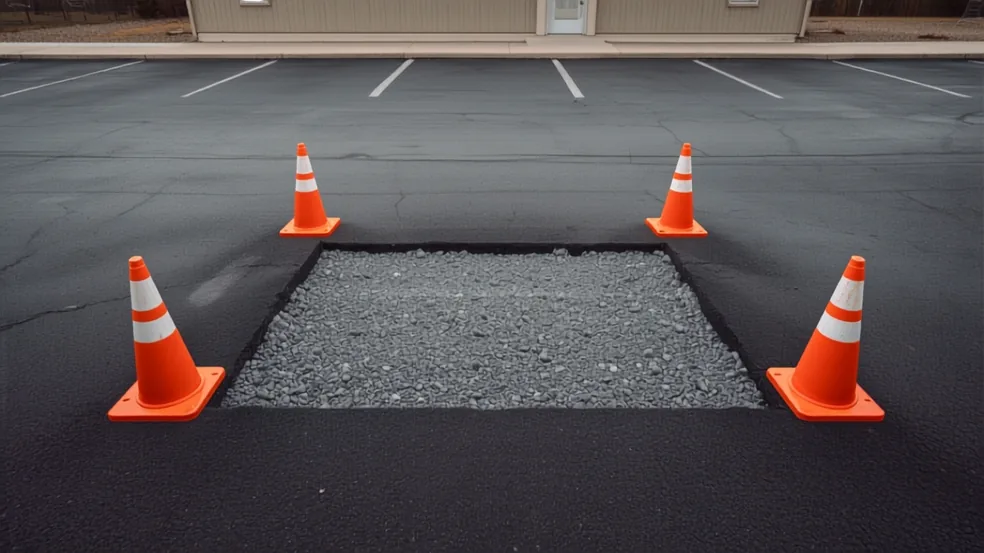
Why commercial repair scopes get rewritten mid-job
A repair scope for a parking lot is two documents pretending to be one. The first describes pavement: which areas come out, how deep, what goes back in. The second describes the site: how customers still reach the door, how a tractor trailer still reaches the dock, where refuse collection happens on the week the dumpster pad is open ground. Most proposals contain only the first one.
That is why so many of these jobs go sideways. The pavement work itself is routine. The disruption is not, and the disruption is what a property manager, an HOA board, a church council or a practice administrator is actually being asked to approve. A document that lists square yardage and tonnage and says nothing about access is asking somebody to sign for an unknown quantity of angry tenants.
The useful version of this conversation starts from the operating pattern and works backwards to the pavement. When does the site fill and when does it empty. When do deliveries arrive. Which doors have to stay reachable. How much parking has to remain available, and where it has to be. Once those are settled, the order of the repair areas more or less writes itself, and the scope turns into something a board can vote on rather than something it defers for another year.
Triage on a lot is a different exercise from triage on a driveway
A driveway is one surface with one use. A parking lot is several surfaces sharing a boundary line, and each of them carries a different load a different number of times a day. Rolling that into a single condition rating throws away the only information worth having.
Useful triage maps distress by area. The drive aisle from the entrance to the rear of the building is one zone. The parking bays on either side of it are another. The dumpster approach is a third. The dock apron, where there is one, is a fourth. Each gets looked at on its own terms, because each is failing, or not failing, for reasons of its own.
The second half of triage is ranking, and ranking is where most condition surveys quietly go wrong. The instinct is to rank by severity, which puts the ugliest area at the top of the list. The better question is which distress compounds fastest. A large patch of faded, weathered surface in a corner nobody drives on looks terrible and is changing very slowly. A single open crack across a drive aisle looks like nothing and is feeding water into the base under the most heavily loaded strip of pavement on the property.
- Compounds fast: water standing anywhere on the lot, interconnected cracking in a wheel path, any distress at a dumpster approach, edges breaking away where vehicles turn, a depression that is visibly deeper than it was at the last inspection.
- Compounds slowly: surface weathering and loss of colour, tight isolated cracks well away from traffic, light surface scuffing, the visible outlines of old patches that are flush and stable.
- Deceptive: a small pothole that keeps being filled. The opening is the visible end of a cavity in the layers below, and that cavity grows on its own schedule whether or not anybody attends to the top of it.
Ranking this way usually reorders a maintenance list dramatically, and it frequently makes the total smaller rather than larger, because several of the areas that were going to be addressed on appearance turn out to need nothing structural at all.
Commercial lots fail where load concentrates, not where area is greatest
Parking bays take up most of the square footage of a typical lot and they are rarely the problem. A parked car applies a modest load and applies it while sitting still. Failures cluster in a small fraction of the total area, and the pattern is consistent enough across sites in this metro to be predictable before anybody walks it.
- Drive aisles. Every vehicle that enters the site crosses them, and every truck crosses them fully loaded. An aisle takes in a week what a parking bay takes in a year.
- The entrance throat. That short length between the public road and the lot proper absorbs a turning load from every vehicle that uses the site, often while the vehicle is still braking or accelerating, and it frequently sits exactly where water coming off the road wants to run in.
- Dumpster approaches and pads. A refuse truck is among the heaviest vehicles that will ever use the property, it arrives along the same line every week, and at the pad it stops, lifts a loaded container over its own cab and sets it down again. That is a static load, a dynamic load and a point load from stabilisers all landing in one small rectangle.
- Dock aprons. A trailer reversing to a dock puts the weight of its rear axles onto a small area while turning, and the landing gear then parks a concentrated point load on the surface for as long as the trailer sits there. Humid summer heat in this region softens a surface enough that the impression left behind is permanent.
- Turning areas and the ends of aisles. Turning a heavy vehicle applies shear at the surface rather than straight downward pressure. Asphalt takes compression well and shear poorly, which is why pavement at a turn scuffs, shoves and ripples before it ever cracks.
What links all of those is load concentration rather than area. It is why a lot can look uniformly tired and still need work in only a handful of clearly defined rectangles. It is also why a lot that was resurfaced from edge to edge five years ago can already be failing in exactly the same five places, because the resurfacing changed the appearance of the whole site and the structure of none of it.
The same point explains a common and expensive misdiagnosis. When a dumpster approach fails over and over, the answer is usually not better asphalt. It is a heavier pavement section along the approach line, or a concrete pad at the precise point where the truck stops and lifts, because that particular combination of loads is a poor match for asphalt no matter how well the asphalt is built.
Full-depth repair or surface patching, and what actually decides it
Surface patching removes the top layer of asphalt across a defined area and replaces it. Full-depth repair takes everything out down to the base or the subgrade, deals with whatever is found there, and rebuilds from the bottom. The cost difference between them is large. The choice is still not a budget preference, because in most situations only one of the two will hold.
The deciding question is which layer failed. If the problem lives in the surface, surface work is correct and full-depth is money spent on a layer that was fine. If the problem lives below the surface, a surface patch is a lid, and the lid comes off on roughly the same schedule the original failure ran on.
- Points to full depth: interconnected cracking in a pattern across a wheel path or a turning area, which means the pavement is flexing because what sits under it has stopped spreading load.
- Points to full depth: a patch in the same location that has already been replaced once. A second failure inside the same rectangle is information. The cause sits deeper than the first repair went.
- Points to full depth: any area that both holds water and is cracked. Water plus an open route downward means the base is already in the story.
- Points to full depth: a depression that is still getting deeper between inspections, because something underneath is consolidating or washing out.
- Points to full depth: soft or pumping material at the face of a test cut, where wet fines are being pushed up under load.
- Points to surface work: raveling and loss of the top material across an area that is otherwise firm and level.
- Points to surface work: isolated cracking away from wheel paths with no deformation around it.
- Points to surface work: damage from a spill, a fire or a dropped load, where the injury is genuinely confined to the top layer.
- Points to surface work: scuffing and shoving at a turn where the pavement underneath is sound and only the surface has moved.
West and north of the city, on Piedmont red clay, the odds tilt toward full depth more often than owners expect. The dominant failure mode there is not asphalt wearing out; it is a slow-draining subgrade that loses bearing capacity while it is saturated and takes days or weeks to recover. East and south, out onto the coastal plain, the soils change to sand, silt and marine clay and the story is more often about fines migrating and voids opening up. Both of those are below-surface problems, and the layer that failed is the layer that has to be rebuilt.
The honest way to settle it on site is to cut one. A test excavation in a representative failed area answers the question in an hour and costs a fraction of being wrong across an entire lot. A proposal that specifies full-depth repair over large areas without anyone having opened the pavement is guessing, and so is a proposal that rules it out on the same evidence.
Phasing an occupied site is the scope, not a footnote at the end of it
New asphalt cannot be driven on straight away and an open excavation cannot be driven on at all. So every repair area on a working lot is, for a period, a hole in the circulation of the site. Phasing is the work of deciding which holes can exist at the same time without the property becoming unusable.
The practical unit is a work cell: a defined area, physically closed off, with a defined start and a defined moment at which it takes traffic again. Cells are sized by what the site can afford to lose, not by what is convenient to pave. A medical office with a full morning schedule and a small retail centre with a lunchtime peak lose different things at different hours, and the cells should be drawn to match.
- Isolation. Barricades and cones that genuinely enclose a cell rather than decorate it. A cone people drive around is a suggestion. Signage belongs at the point where a driver makes the decision, not at the edge of the hole where the decision has already been made.
- Vehicle routing. Where a two-way aisle becomes one-way for the duration, which bays close to preserve turning room, and whether the entrance and the exit need to swap roles while a cell is open. Fire access has to be kept available throughout, and what counts as available is set by the local fire authority rather than by what seems reasonable on the day.
- Pedestrian routing. People walk the shortest line available to them. If the shortest line crosses the work area, they will take it, in the rain, carrying something. A temporary walking route has to be either shorter or far more obvious than the route through the cell, or the cell has to be closed in a way that physically prevents the shortcut.
- Accessible parking and a connected accessible route. Accessible spaces, their access aisles and the route from them to the entrance have to stay available and joined up for the whole of the work, which in practice means relocating them temporarily rather than simply losing them for a fortnight. What is acceptable as a temporary arrangement is a matter for the applicable rules and for whichever authority has jurisdiction over the property, and it is worth settling with them, and with a professional engaged on the project, before the first saw cut rather than after the first complaint.
- Deliveries and refuse collection. A dock apron out of service means the delivery schedule changes or a temporary receiving point exists somewhere a truck can actually reach. A dumpster pad out of service means the container moves to a position the refuse truck can still service, and that position has to be pavement capable of taking the truck, which rules out most of the lot.
- Return to service. Every cell needs a stated time at which it reopens, and the tenants need that time in advance rather than on the morning. Most of the friction on an occupied-site job comes from uncertainty rather than from closure itself.
Night and weekend work removes a great deal of this difficulty and is worth asking about wherever the site allows it. The limits are real, though. Noise matters where residential neighbours are close, which rules it out on a good many suburban sites in Chesterfield, Glen Allen and Mechanicsville. Lighting has to be adequate for placing and compacting properly rather than merely adequate for seeing. And temperature matters, because on a clear night in the shoulder seasons the air here drops further and faster than people expect.
Cure and traffic timing belongs in the schedule, not in the small print
Hot mix asphalt does not cure in a chemical sense. It is placed hot and gains strength as it cools, so the question of when an area can take traffic is really a question of how quickly the heat leaves it. That is governed by the thickness placed, the air temperature, the temperature of the ground it was placed on, wind, and whether the sun is on it.
The consequence is seasonal, and it runs the opposite way to most people's intuition. The same repair that is firm enough to open within hours on a cool, breezy October afternoon can still be soft at close of business in humid July heat, when the pavement temperature stays high long after the crew has left. Midsummer work on lots in this metro frequently needs a longer closure for that reason alone.
Soft new asphalt does not fail dramatically. It takes impressions. A car parked on it, a trailer jack, a kickstand, a dumpster wheel or a delivery cart leaves a depression that never comes back out, and that depression then collects water for the rest of the life of the pavement. The closure period is not caution for its own sake. It is what stops a fresh repair from starting its own next defect on the day it opens.
Other materials on the same job run on different clocks, and the slowest one sets the phase. Cold-applied material behaves differently from hot mix. Crack sealant needs to set before it is driven on or it tracks across the lot on tyres. Concrete, where the scope includes a dumpster pad, a curb or an apron, needs far longer than anything asphalt does and is almost always the item that decides how long an area is out of service. Where concrete is in the scope, plan the phase around the concrete and fit the asphalt to it.
Sealcoating and line marking have windows of their own and they come last. That matters to phasing because it means an area can reopen to traffic and still need a second, shorter closure later on, and tenants should be told about both closures at the same time.
Manhole frames and catch basin castings are part of a repair scope
Most commercial lots have structures set into the pavement: sanitary manhole frames and covers, storm inlets, catch basin castings, valve boxes, sometimes an interceptor lid behind a restaurant. They are rigid and fixed to something below. The asphalt around them is flexible and fixed to nothing. That difference produces a specific and very common failure.
When a casting sits proud of the surrounding surface, every vehicle crossing it strikes the rim. The impact breaks down the asphalt in a ring around the frame, water gets into the ring, the ring widens, and before long the material immediately around the casting is loose and the frame itself begins to move. A proud casting in a drive aisle is one of the fastest-compounding defects on a commercial lot, and it is also the one most likely to generate a vehicle damage complaint.
When a casting sits low, the depression around it collects water and delivers it directly to the joint between a rigid structure and flexible pavement. That joint is the weakest point in the waterproofing of the entire property. A sunk casting is a slow leak into the base, aimed at the base, running every time it rains.
Either condition is usually a symptom of history. The lot was overlaid at some point and the structures were never raised to match, or the pavement around the structure has consolidated over the years while the structure, founded on something far more solid, has not moved at all. Either way the asphalt around it is now broken, and the fix is to adjust the frame to the finished grade rather than to keep replacing the ring.
Adjusting a casting means taking out the pavement around it, lifting or lowering the frame on the structure below, resetting it to the elevation the completed surface will hold, and reinstating the pavement properly around it. It is a distinct item of work. A proposal that repairs a lot full of distressed castings without mentioning any of them will not hold, because the same ring failure reappears around every one of them within a few seasons.
One practical point worth raising before the work starts: the structures in a lot often belong to different parties. Some are the property owner's and some belong to a utility. Establishing which is which at the survey stage avoids a phase stopping dead while somebody finds out.
What deferral costs, described as mechanisms rather than figures
Every maintenance list gets cut. The question worth answering is which items are genuinely postponable and which become materially more expensive with each season they sit, and that is a question about mechanism rather than about opinion. An item gets more expensive to defer when the thing causing it keeps running while you wait.
- Grows while you wait: anything admitting water into the base. An open crack in a wheel path, a failed joint, a broken ring around a casting. Each wet season the base underneath loses capacity across a wider footprint, so the rectangle that eventually has to come out is bigger. You are not deferring the same job. You are deferring a larger one.
- Grows while you wait: standing water. A depression sits over the wettest subgrade on the property, keeps consolidating because of it, and therefore holds more water next year than it does this year. That one accelerates rather than merely continuing.
- Grows while you wait: a pothole in a traffic path. The opening enlarges with every vehicle and the edges break back around it, so the area that has to be cut out is measurably larger by the end of a season. There is a vehicle damage exposure attached to it as well that has nothing to do with pavement engineering.
- Grows while you wait: distress at a dumpster approach or a dock apron. The load that caused it arrives on schedule no matter what the budget cycle decided, so the mechanism runs at full rate all year.
- Grows while you wait: a proud or sunk casting. The ring widens under repeated impact until the structure itself needs attention rather than just the pavement around it.
- Genuinely waits: surface weathering and loss of colour on a sound pavement. That is oxidation. It is not structural and it does not accelerate.
- Genuinely waits: tight isolated cracks in a parking bay away from wheel paths, provided they are not holding water. Worth sealing at the next convenient opportunity, not worth an unplanned mobilisation.
- Genuinely waits: the visible outlines of old patches where the patch itself is flush and stable. That is a cosmetic line, not a defect.
- Genuinely waits: light scuffing at a low-traffic turn with no deformation underneath it.
This distinction matters more on a lot than on a driveway because a lot has a budget cycle attached to it, with a board or an owner making one annual decision. Presented as a single number, the whole list gets deferred. Presented as two lists, one explaining why an item grows and the other saying plainly that an item can wait, the structural work usually gets approved and the cosmetic work usually gets postponed, which is the right outcome in both cases.
The most useful sentence in a commercial pavement proposal is the one saying that something on the list does not need doing this year. If nothing on a proposal is postponable, nobody has thought about it properly.
Rebuilding the failed areas while the site keeps trading — common questions
Can the lot stay open while the repairs are done?
On almost every site, yes, provided the work is broken into cells and the closures are planned around how the property actually trades. What cannot happen is the whole lot being treated as one work area. The practical questions are how much parking can be lost at once, which doors have to stay reachable, and whether deliveries and refuse collection can be rerouted for the days an area is out of service.
How long before a repaired area can take traffic again?
It depends on how fast the new material cools, which depends on thickness, air and ground temperature, wind and sun. Cooler, breezier conditions release an area sooner; humid summer heat holds the surface soft for longer and often needs a longer closure. If a concrete pad or curb is part of the same repair, the concrete sets the timetable and everything else waits on it.
Which areas of a parking lot should be repaired first?
Rank by what compounds fastest rather than by what looks worst. Anything letting water into the base, anything holding water, and anything at a dumpster approach or dock apron moves to the top, because the mechanism causing those keeps running. Faded surface and tight isolated cracks in a quiet corner of the lot can usually wait a season without the job getting bigger.
Why does the patch by our dumpster keep failing?
Because a refuse truck applies a combination of loads that asphalt handles badly, in the same place, on a weekly schedule. It arrives heavy, stops, lifts a loaded container over its cab and sets it back down. Replacing the same patch in the same asphalt repeats the result. The fix is usually a heavier pavement section along the approach and a concrete pad at the point where the truck stops and lifts.
How do you tell whether an area needs full-depth repair or a surface patch?
By working out which layer failed. Interconnected cracking in a wheel path, standing water over cracked pavement, a depression that keeps deepening, or a patch that has already been replaced once all point below the surface. Raveling, isolated cracks away from traffic and damage from a spill point to the surface. Where it is genuinely unclear, a test cut in one representative area settles it in an hour.
The manhole cover in our drive aisle has broken asphalt all around it. Is that a pavement problem?
It is a level problem showing up as a pavement problem. If the casting sits above the surface, every vehicle strikes the rim and breaks the asphalt back in a ring. If it sits low, the dish around it pours water straight into the joint between the rigid structure and the flexible pavement. Patching the ring without adjusting the frame to finished grade puts you back in the same position within a few seasons.
We can only fund part of the list this year. What should we cut?
Cut the items whose mechanism has stopped and keep the ones whose mechanism is still running. Weathered surface, stable old patch outlines and tight cracks away from wheel paths are all postponable. Water entry, standing water, potholes in a traffic path and anything at a truck route are not, because each of those returns next year as a bigger rectangle rather than the same one.
Will we lose our accessible parking while the work is going on?
The intention should always be that accessible spaces, their access aisles and a connected route to the entrance stay available throughout, usually by relocating them temporarily rather than closing them. Whether a given temporary arrangement is acceptable is a question for the applicable rules and for whichever authority has jurisdiction, so settle the plan with them, and with a professional engaged on the project, before the work starts rather than after somebody raises it.
Talk through your site
Start with the address, roughly how many square feet, and photographs of the worst areas and anywhere water sits after rain.
Related work
Driveway Paving
New asphalt drives, replacements and widenings, from the subgrade up.
Driveway Repair
Potholes, edge failure, settling and the cracks worth chasing.
Sealcoating & Driveway Sealing
What it protects, what it cannot fix, and when it is money wasted.
Asphalt Repair
Patching, full-depth repair and reading what a failure is telling you.
Parking Lot Paving
New lots and full reconstruction for commercial and multifamily sites.
Parking Lot Striping & ADA Layout
Layout, stall counts, accessible spaces and fire lanes.
Where we do it
Powhatan
Long rural drives, gravel conversions and gravity that works against you.
Chesterfield
Suburban drives and the county clay that decides how long they last.
Glen Allen
West-end subdivisions, commercial strips and tight HOA standards.
Ashland
Older streets, mature trees and root damage under the mat.
Mechanicsville
Hanover-side drives and a lot of deferred maintenance.
Midlothian
Newer construction on ground that has not finished settling.