Home › Services
The one condition sealer was actually built to treat
Sealcoating is the most oversold product in this trade, and it is also genuinely worth buying on one particular driveway. Working out whether you own that driveway is the entire decision.
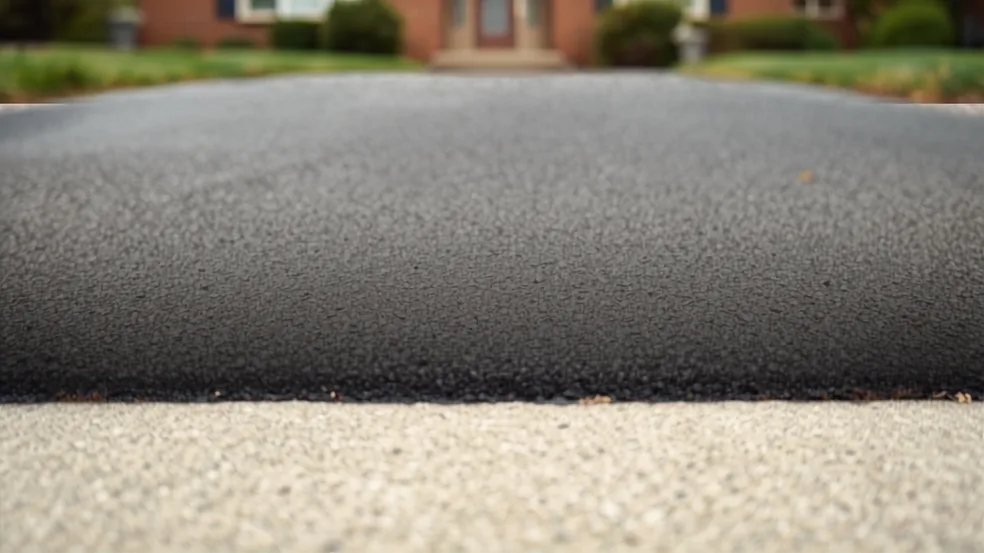
Oxidation is a chemical change in the binder, not a colour problem
Asphalt pavement is stone held together by a petroleum binder. The stone does not change in any meaningful way over the life of a driveway. The binder changes continuously, from the day it is placed.
Oxidation is what happens when oxygen reaches that binder and reacts with it. Ultraviolet light speeds the reaction up, heat speeds it up further, and a humid central Virginia summer supplies a generous amount of both. The lighter, more mobile fractions of the binder are driven off or converted, and what is left behind is stiffer, harder and far less willing to stretch.
A young binder can deform under a load or a temperature swing and then recover. An oxidised one cannot. It has lost the ability to relax, so rather than flexing around movement it fractures at a very small scale, over and over. That is the whole of the ageing process, and it works from the top down, because the top is where the oxygen and the sunlight are.
Colour is the visible proxy for all of this. Black is a binder-rich surface. Grey is exposed aggregate with a thin, hardened film of binder still clinging to it. A driveway that has gone the colour of a sidewalk is reporting that the reaction is well advanced in the top few millimetres of material. It is reporting nothing whatsoever about the base underneath, and that is the distinction most sealcoating conversations skip past.
Raveling, stage by stage, and how each stage feels under a hand
Raveling is the physical consequence of oxidation. Once the binder can no longer hold the aggregate in place, the aggregate leaves. It goes in a predictable order, and you can identify the stage yourself in about a minute.
- Early. The surface still looks reasonably uniform, but the fine particles have begun to go. Run a palm across it and it feels dry and faintly chalky rather than smooth. A patch that gets wet in the rain dries to a lighter shade than it used to. Nothing is coming loose in the hand yet.
- Moderate. The texture is now clearly coarse, something like heavy sandpaper. Individual stones stand proud of the surface instead of sitting down in it. Sweeping brings up a small quantity of grit that was not there a year ago, and the open areas are noticeably paler than the strip that lives under a garage overhang or a deep shadow.
- Advanced. Stone comes away under a shoe or a turning tyre. There is a permanent line of loose aggregate along the edges and at the foot of any slope, because rain carries it there and leaves it. The profile itself is going uneven, and small open pockets appear where several adjacent stones have gone together.
The first two stages are the sealer window, and they are the reason the product exists. A surface that is drying out and shedding fines still has a sound, continuous matrix left to accept a coating and to hold it in place. Slowing the rate of further oxidation there genuinely extends how long the wearing course stays serviceable, which is a real benefit on a real driveway.
The third stage is normally past it. Once the surface is losing stone in quantity and the profile has opened up and gone pitted, sealer has very little to grip and even less left to protect. It sinks into the voids, looks acceptable for a season, then lifts away in flakes carrying the loose aggregate it was resting on. At that point the honest conversation is about new material, not about a coating.
What sealer is, and the three things it genuinely does
Sealer is a thin liquid coating, applied cold, that dries into a flexible film on top of the wearing course. Depending on the product it is based on a refined tar or on an asphalt emulsion, carried in water, with fine sand or similar filler suspended in it to give texture and grip. Cured, it is measured in fractions of a millimetre. It is a coating in the same sense that paint on timber is a coating.
Three of its benefits are real and worth paying for on the right surface.
- It is a consumable wearing layer. Tyre scuff, wind-blown grit, sun and rain go to work on the film instead of on the binder beneath it. The film is meant to be used up, which is precisely why it has to be renewed at some point.
- It resists petroleum. Gasoline, motor oil, transmission fluid and hydraulic fluid dissolve asphalt binder, which is why the parking spot under an older vehicle develops a soft, shiny, slightly sunken patch. A cured sealer film is far less soluble in those fluids and buys you time to get a spill cleaned up before it reaches the pavement.
- It restores appearance. A clean dark surface with a crisp edge against the grass or the concrete apron makes an entire frontage read as maintained, and that is a legitimate thing to want.
Those are the honest claims, and they are worth making plainly because they are so often inflated. Notice what none of them involve: load, thickness, or the ground underneath.
What sealer categorically cannot do, and the reason in each case
Every item below is ruled out by physics rather than by product quality. No brand, no formulation and no number of coats changes any of it.
- It adds no structural capacity. Load is carried by a compacted stone base and spread out into the subgrade below it. A film a fraction of a millimetre thick, applied with a squeegee or a spray wand, carries nothing and contributes nothing to how a wheel load is distributed.
- It will not bridge a crack that is moving. A crack opens and closes with temperature and flexes under traffic, through a range far greater than a thin film can absorb, especially when that film is cold and therefore at its most brittle. Sealer laid across a live crack tears along the same line, usually inside the first winter and sometimes within the first week.
- It will not fix a depression. A low spot is a shape, and coating a shape leaves you with the shape. Water stands in the identical footprint afterwards, on a darker surface. Anyone proposing to build sealer up in layers to level a dish is proposing the failure described in the next section.
- It will not slow a failure that starts underneath. Where the base is saturated or the subgrade is moving, the damage is arriving from below and the surface is only where you are seeing it. A coating changes nothing about the water, the drainage or the load path.
That last point deserves to be put bluntly. Sealer applied over an area that is failing structurally does not merely fail to help. It erases the evidence you would have used to catch the problem while it was still small and cheap, and it does so for long enough that the next person to look at the driveway is looking at a worse one.
So the decision rule is short. Where the surface is sound and simply tired, a coating is money well spent. Where water stands anywhere on it, where the cracking encloses shapes instead of running as lines, or if a patch has already been redone more than once, the right answer this year is to decline the coating and spend the money on the cause.
When the sealer itself becomes the defect
Sealer is designed to wear away. Applied on an interval shorter than it takes to wear away, it accumulates, and accumulated sealer behaves nothing like the film a single application produces.
A thick multi-layer build is brittle. It has no aggregate skeleton and little flexibility of its own, so when the asphalt beneath expands on a hot afternoon and contracts on a cold night, the coating cannot follow the movement. It cracks. Because each layer went down at a different time and has aged to a different stiffness, the layers also begin to separate from one another.
The signature is easy to recognise once you know what you are looking at.
- Fine cracking in a tight, shallow web, often compared to dried mud or to the crazing on old glazed pottery. It is much finer than anything the pavement itself produces, and it stops at the coating.
- Flakes and chips that lift at an edge and peel, revealing grey asphalt underneath rather than more black.
- A visible ridge of thickness where the sealed area meets a concrete apron or a walkway, like the built-up edge of repeatedly painted trim.
- A surface that looks closed and slick rather than textured, and that gets noticeably slippery when it is wet.
Lift a flake and look at its underside. The layers are usually visible and countable. Cracking that stops at the coating and does not carry on down into the asphalt is a coating problem, not a pavement problem, and the remedy is to stop applying and let the surface wear off rather than to apply again over the top of it.
This is why a short reseal interval should be read as a cost rather than as diligence. A crew offering to come back every single year is not offering more protection. A film that has not worn off does not need replacing, and a schedule set without reference to whether it has worn off is a schedule being written by the invoice rather than by the pavement. Look at the surface instead. Seal when the black is genuinely gone and the texture has opened up again.
Preparation is the part that decides the outcome
Sealer has to stick to what is under it, and there is very little it will stick to except clean, dry asphalt. Most sealcoating that fails early failed at this step rather than in the bucket, which is also why the same product can look excellent on one property and be peeling on the next one by spring.
Cleaning is not cosmetic. Dirt, sand, leaf litter and the fine grit that raveling has already produced act as a release layer: the coating adheres to the debris, the debris does not adhere to the pavement, and the film lifts as a sheet. Doing it properly means blowing and sweeping the whole surface, scraping and wire-brushing wherever moss or compacted soil has taken hold, and cutting the grass and soil back off the perimeter. On a shaded driveway in this region that perimeter creep can amount to several inches of soil and root mat that nobody has looked at in years.
Oil and fuel spots need separate treatment, because sealer will not adhere over them at all. The contamination has softened and partly dissolved the binder, and the residue repels a water-carried coating the way a greasy pan repels water. The spot has to be scraped back and degreased, and if it has soaked in deeply it needs a primer made for the purpose before any sealer goes near it. Skip that and you get a driveway that is uniformly black except for the precise outline of every place a vehicle has ever leaked, reappearing within weeks.
Moisture is the third way it goes wrong. Sealer carried in water cures by giving that water up. If the asphalt is already damp, or if a shaded section has not properly dried since the last rain, the film cannot release its water evenly and it sets soft, thin and poorly attached. This is a live problem here rather than a theoretical one, because the same canopy that makes a driveway pleasant in August keeps parts of it damp for a day or more after the open sections have dried. A morning that looks fine from the street can still be too wet at the far end.
Cracks get dealt with before sealing, not by sealing. Sealer run into an open crack shrinks as its water leaves, drops below the surface and leaves a dark recessed line that is still a direct route into the base. That is a separate operation, done first, with a different material.
Crack sealing is a different product, and usually the better buy
Crack sealing uses a hot-applied rubberised material, melted and placed into a crack that has been cleaned out and often routed to a consistent shape first. It stays flexible after it cools, by design, so it can stretch when the crack opens in January and compress when it closes in July. It is not a coating and it does not cover the whole surface. It treats specific defects, one at a time.
The purpose is different as well, and that is the part worth understanding. Sealcoating slows the ageing of a surface. Crack sealing keeps water out of a structure. Those two are not comparable in value, because surface ageing is slow and largely cosmetic in its early years, while water in the base is the mechanism behind nearly every expensive pavement failure this region produces.
On most properties around Richmond, the higher-return purchase is the one that keeps water out. Piedmont clay holds water against a base for days rather than hours, so every open crack that reaches down into the base is a funnel pointed at a place that drains slowly and loses strength when it is wet. Sealing a modest run of cracks on a sound driveway protects the part of the assembly that actually carries the car. A full coating on the same driveway makes it look better, which is a different kind of value and should be priced as one.
If the budget this year only stretches to one of the two, seal the cracks. If it covers both, seal the cracks first and coat afterwards. The reverse order buries the cracks under a film that is going to tear along them regardless.
Temperature, cure time, and the case for getting it done before winter
Sealer cures by evaporation, so it is governed by pavement temperature, air temperature, humidity and how much sun the area receives. The common working rule is that the surface and the air should both be comfortably above about fifty degrees Fahrenheit and rising, with no rain in the forecast for a day or more afterwards, and no overnight drop toward freezing while the film is still green.
Falling temperature is a bigger problem than low temperature. A film applied at four in the afternoon in late October has a short window of warmth and a long, cold, damp night in front of it, and a film that is still curing when the dew lands never reaches its proper hardness. On a marginal day the correct answer is to come back on a better one, and a crew that says so is telling you something useful about how it works.
Cure before traffic matters more than people are generally told. Foot traffic can usually return within a day in good conditions. Vehicles need longer. Turning a steering wheel while the car is standing still will scuff an immature film straight off the surface in a neat arc, and shade extends every one of these intervals, sometimes considerably.
The argument for sealing in the autumn rather than waiting for spring rests on how winter works here. Richmond winters are mild in absolute terms, which is exactly why they get discounted. What damages pavement is not the depth of the cold but the number of times the temperature crosses freezing, and here it crosses back and forth constantly through the season. Every one of those crossings is another opportunity for water held in an open surface void to expand and lever it wider. Going into the season with an intact film and with the cracks already sealed means there are fewer places for that water to sit. Going in with an open, raveling surface means each cycle does a small amount of permanent work on the pavement.
Shade, moss, algae and pollen under a mature canopy
A great deal of this metro sits under old hardwoods, and a driveway in that setting lives a different life from an identical driveway on an open lot in a newer part of Glen Allen or Chesterfield. It changes what sealing is worth and it changes when it can be done.
Shade is genuinely protective in one respect. Less direct ultraviolet light and a lower peak surface temperature mean the binder oxidises more slowly, so a heavily shaded driveway often stays dark longer and reaches the raveling stages later than the sunlit section of the same property. The case for sealing a deeply shaded surface on the same calendar as a sunny one is weak. If it is recommended without anybody looking closely at the surface, that is a fair moment to ask what they saw.
Shade charges for that protection in a different currency. A shaded drive stays wet far longer after every rain, and persistently damp asphalt grows moss and algae, particularly along the edges, under the drip line, and anywhere the grade is close to flat. The growth is not eating the pavement. What it does is hold a film of moisture against the surface more or less permanently, which keeps the material in the condition that lets repeated freezing do its work, and which makes the surface slippery in a way that gets noticed in January.
Spring pollen does something similar over a shorter period. A heavy yellow-green layer, wetted by rain, becomes an organic mat that keeps the surface damp and traps grit against it. It washes off. It is not a reason to seal, and it is not evidence that anything is failing.
What all of this means for the sealing decision is narrower than it first sounds. Moss, algae and pollen are preparation problems, not conditions that sealer treats. They have to be removed, and the surface has to be genuinely dry before anything goes on it, which on a shaded drive may mean several consecutive dry days rather than one clear morning. Coating over a green film buys a driveway that lifts in sheets the following spring. And if a drive is shaded and damp enough that it cannot reliably be dried out at all, that is an argument for spending the money on drainage and on cutting back what overhangs it, rather than on a film that will not stay attached to it.
The one condition sealer was actually built to treat — common questions
How do I tell whether my driveway is ready for sealer or already past it?
Use your hand rather than your eyes. If the surface is grey and feels dry or mildly gritty but nothing comes away when you rub it, that is the window sealer is built for. If stone comes loose under a shoe, if there are open pockets where several stones have gone, or if loose aggregate collects along the edges after every rain, the surface has moved past what a coating can hold together and the money is better spent on new material.
How often should an asphalt driveway be sealed?
On wear, not on a calendar. Sealer is a consumable film, and the right moment to renew it is when it has substantially worn off and the surface has gone grey and open again. That interval depends on sun exposure, traffic and shade, so two driveways on the same street can legitimately be on very different schedules. An annual reseal is almost always putting new material over old material that has not worn out yet.
The last sealcoat cracked within a year. Was it a bad product?
Usually not. The three common causes are a build-up of previous coats that has gone brittle and crazed, an application over a surface that was dirty or still damp, and sealer laid across a crack that was still moving underneath it. Lift a flake and look at the back of it. Countable layers point to over-application, and cracking that stops at the coating without continuing into the asphalt confirms the problem is the film rather than the pavement.
Will sealcoating fill the cracks in my driveway?
No, and attempting it makes the cracks harder to treat properly later. Sealer is carried in water and shrinks as that water leaves, so it settles below the surface of a crack and leaves a recessed dark line that still admits water. Working cracks need a flexible hot-applied material placed into them as a separate operation, done before any coating goes down.
Should a brand new asphalt driveway be sealed right away?
No. New asphalt needs time to cure and to give off the lighter volatiles in its binder, and coating it early traps them and can leave the surface soft. New pavement also has plenty of binder at the surface already, which is the thing sealer exists to protect. Waiting through at least a full season, and generally longer, costs nothing and avoids the problem.
Does sealcoating make a driveway slippery?
A correctly applied coating carries fine aggregate in suspension specifically to keep texture underfoot, so it should not. Slickness is a symptom of something else: too many accumulated layers producing a closed, glassy film, or a coating that was applied over moss and algae that are still growing underneath it. On a shaded drive the biological growth is the more likely culprit, and that has to be removed rather than covered.
Is it better to seal in the autumn or wait until spring?
Autumn, if the weather cooperates and the surface can be got properly dry. The winter here crosses freezing a great many times even though it is not severely cold, and each crossing works on water sitting in an open surface. Going into that season with a sound film and sealed cracks means fewer places for water to sit. The one thing not worth doing is forcing an application onto a cold, damp day just to finish before the season closes.
My driveway is under heavy tree cover and never seems to dry. Does that change the advice?
Yes, in both directions. Constant shade slows the oxidation that sealer is meant to address, so the surface often needs coating less often than a sunny one. At the same time the moss, algae and permanent dampness make it much harder to prepare properly, and a film applied to a surface that is not dry will lift within a season. On that kind of property, drainage work and cutting back the overhanging growth do more good than any coating.
Talk through your site
Start with the address, roughly how many square feet, and photographs of the worst areas and anywhere water sits after rain.
Related work
Driveway Paving
New asphalt drives, replacements and widenings, from the subgrade up.
Driveway Repair
Potholes, edge failure, settling and the cracks worth chasing.
Asphalt Repair
Patching, full-depth repair and reading what a failure is telling you.
Parking Lot Repair
Keeping a working lot open while the failed areas get rebuilt.
Parking Lot Paving
New lots and full reconstruction for commercial and multifamily sites.
Parking Lot Striping & ADA Layout
Layout, stall counts, accessible spaces and fire lanes.
Where we do it
Powhatan
Long rural drives, gravel conversions and gravity that works against you.
Chesterfield
Suburban drives and the county clay that decides how long they last.
Glen Allen
West-end subdivisions, commercial strips and tight HOA standards.
Ashland
Older streets, mature trees and root damage under the mat.
Mechanicsville
Hanover-side drives and a lot of deferred maintenance.
Midlothian
Newer construction on ground that has not finished settling.